Prayer
Importance of prayer
Prayer is the very soul of religion. Auguste Sabatier (1897, p. 109) (Spilka & Ladd, 2013)
“The most intimate essence of religion is revealed by the most simple religious act: prayer.” (Feuerbach, L., 19th century German philosopher)
Introduction
The General Social Survey’s analysis of national data from 1972 to 2006 suggests that as many as 97% of Americans pray, and some 57% indicate that they pray one or more times each day (General Social Survey, 2008).
Laird (1991) reported on a Princeton University survey that found “74% of men and 86% of women rely on prayer when faced with a problem”
Why is so important?
a wide-ranging perspective.
relevant to both personal and social psychology
it is complex behavior of fundamental importance to the lives of most people
encompassing a broad spectrum of attitudes, beliefs, experiences, and knowledge.
Faith is expressed in many ways, and prayer is part of a larger framework of beliefs, experiences, and observances
Life-span perspectives
praying begins early (childhood, adolescence, adulthood, and old age)
Integral to coping with the problems of living!
prayer reflects the perceptions, cognitions, and motivations of those who pray
include whole person: psychological system, brain activities, body changes
helping people cope with the problems encountered in social living. For example, prayer is significant in marriage and family life, especially when confro
every aspect of clinical, social, and experimental psychology has a place in our efforts to comprehend this most basic of human activities. Prayer is truly critical to the way most people conduct their lives (Spilka & Ladd, 2013).
Definition and metaphysical dimension
- central metaphysical assumptions underlying prayer: Does God hear and answer prayers?
- prayer were largely ignored or rejected by mainstream psychologists
- We can define prayer as an appeal to a higher power
- Prayer is communication
- Contemporary definitions generally emphasize that prayer is an act of communication, often employing such terms as “address” or “request,” with “need” constituting the most frequent motivation for initiating prayer
- Prayer as the name we give to the experience of being in communication with God
Public and Private
- Worship vs. prayer
- The term “worship” has been applied to virtually all religious activities.
- Concept of worship: collective religious activity in which large numbers of people participate in orderly structured public services, usually within an institutional (i.e., church) setting (Clark, 1958) according to (Spilka & Ladd, 2013)
Public and Private
- Prayer is commonly submerged within the complex concept we label as personal faith.
- In recent years, the increasingly popular term used to describe personal faith is “spirituality,” which overlaps with religion. Distinctions between “religion” and “spirituality” are controversial (Spilka & Ladd, 2013).
- The dominant position among psychology researchers treats spirituality as the personalization of religion.
Types of prayer
It is difficult to conceive of them in terms of rigid classifications.
They are enumerated here more on the basis of psychology than on history. (Hamman, n.d.)
Types of prayer
- Petition
- Confession
- Intercession
- Praise and thanksgiving
- Adoration
- Mystical union or ecstasy
- Contemplative
Types of prayer
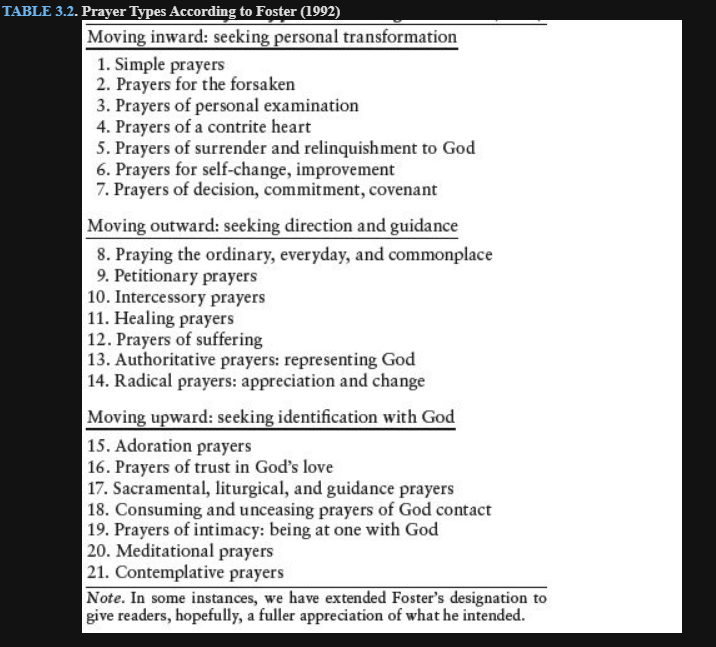
Prayer Types According to Foster (1992)
Empirical dimensions of prayer (factor analysis)
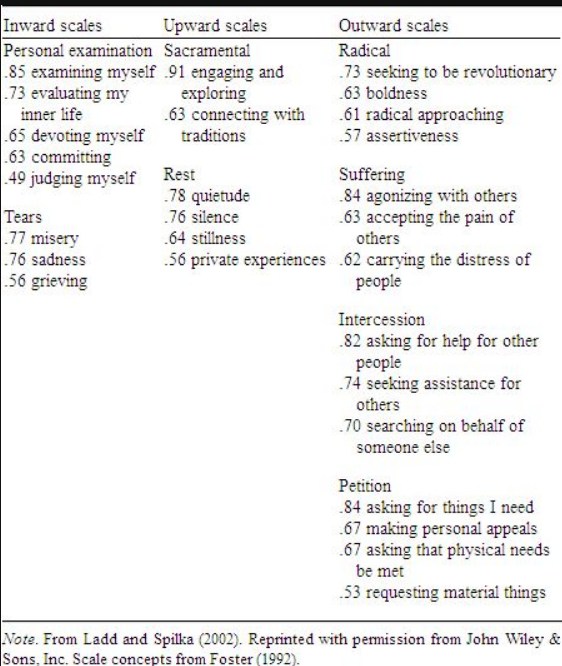
Factor analysis of prayer
Iconography
- Form of prayer
- Reflection processes
- Be in silence
- Practicing patience
- Analysis mistakes and corrections
- Projective technique
Petition
Pargament et al. (2000) consider its key facets to be: (1) the search for meaning; (2) the search for control; (3) comfort/spirituality; (4) intimacy/spirituality; and (5) life transformation. Petitionary prayer is primarily a coping strategy.
Return to health, the healing of the sick, long life, material goods, prosperity, take a spiritual virtues
Christianity has never condemned material requests but rather has integrated them into a single providential order while at the same time subordinating them to spiritual values.
Confession
- at the same time an affirmation of faith and a recognition of the state of sin.
- in ancient Christianity, the confession of faith accompanies the renunciation of demons.
- The Confessions of St. Augustine also illustrate this dual theme.
- The most personal level, sin places a human being directly before God, who alone is able to grant pardon and salvation
- The Miserere (“Lord, have mercy,” Psalm 51) of the ancient Israelite king David expresses repentance for sin with an intensity and depth that has a universal value.
Intercession
solidarity is often expressed in intercessory prayer, in which the needs of others are expressed.
Intercessory prayers are also significant in Eastern and ancient religions.
Christianity: mediation of saints ensures that the prayer will be efficacious.
Intercession is spiritualized in view of a consciousness of the messianic (salvatory) mission.
Interesting research findings in empirical studies
Adoration
- prostration of the whole being before God.
- Adoration takes on its fullest meaning in the presence of the transcendental God who reveals himself to human beings in the religions of revelation (Judaism, Christianity, and Islam).
- Silence and mystic
- Mystic writings, from the East to the West
Jesus Prayer
- also called Prayer of the Heart
- Eastern Christianity - heart of hesychasm, monastic tradition of East christianity in Mount Athos, contemporary documentary film at: https://youtu.be/4UYXxa0nKL8
- mental invocation of the name of Jesus Christ
- repeated continuously
Jesus Prayer
- most accepted form: Lord Jesus Christ, Son of God, have mercy on me
- prayer of the mind
- recommended by the ancient monks of the Egyptian desert (Evagrius Ponticus, Johanes Cassian)
- Hesychasm - monastic system to achieve divine quitness
Lectio Divina
- The Christian form of Lectio Divina was first introduced by St. Gregory of Nyssa (c 330- 395), and also encouraged by St. Benedict of Nursia (c 480-547), the founder of the Benedictine order
- Lectio Divina is a more personal way of experiencing the word through contemplation and reflection.
- Lectio Divina is not a critical analysis of sacred text.
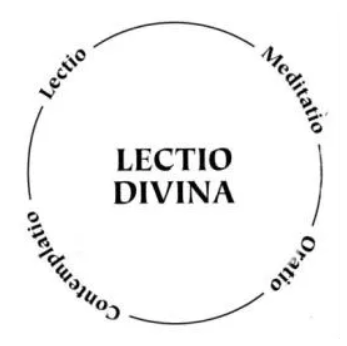
- Lectio Divina has 4 parts: Lectio (read), Meditatio (meditate), Oratio (pray) and Contemplatio (contemplate).
Lectio Divina
Guided Meditation & Lectio Divina: John 20:19-31
Guided Lectio Divina
Guided Meditation & Lectio Divina: John 20:19-31 (https://www.youtube.com/watch?v=cVRsFho-THs)
Centering Prayer and Lectio Divina with Thomas Keating, Part 1 (https://www.youtube.com/watch?v=q7igrkA8OCw&list=PLBE6fmRmYU8gUqT9XVpc5pbfmmDfBuWRk)
Lectio Divina ~ Fr Cassian Folsom, OSB (https://www.youtube.com/watch?v=rAgetB4P4pI)