Introduction to dimensions of Religiousness
Department of Psychology, Faculty of Humanities and Social Sciences
Attention please!
True comprehension of core issues in the psychology of religion requires a background in (Kressel, 2024):
- philosophy
- sociology,
- intellectual history,
- statistics,
- research methodology,
- various subfields of psychology, and
- possibly – theology
Definition of religion (APA)
A system of spiritual beliefs, practices, or both, typically organized around the worship of an all-powerful deity (or deities) and involving behaviors such as prayer, meditation, and participation in collective rituals.
Other common features of organized religions are the belief that certain moral teachings have divine authority, and the recognition of certain people, places, texts, or objects as holy or sacred. (APA Dictionary of Psychology, n.d.)
Definition of religion (Wulff, 1999)
‘all definitions of religion are more or less arbitrary’ James Pratt
Thus, religion ‘as I now ask you arbitrarily to take it, shall mean for us the feelings, acts, and experiences if individual men in their solitude, so far as they apprehend themselves to stand in relation to whatever they may consider the divine’ William James
Religion is a felt practical relationship with what is believed in as a superhuman being or beings Robert Thoules
Religion and spirituality
religion: both individual and an institutional construct
spirituality: increasingly used to refer to the personal, subjective side of religious experience
religious or religiousness: representing as institutional, formal, outward, doctrinal, authoritarian, inhibiting expression
spirituality: individual, subjective, emotional, inward, freeing expression
Dangers of bifurcation or religion and spirituality (Hill & Pargament, 2008)
polarization or religion and spirituality (institutional/individual domain) ignores the fact that all forms of spiritual expression unfold in a social context and that virtually all organized faith traditions are interested in the ordering of personal affairs
implicit in the evolving definitions is the sense that spirituality is good and religion is bad - very simplistic perspective
most people experience spirituality within an organized religious context
SBNR
The Meanings of Religion and Spirituality
Attribution in the psychology of religion and spirituality
Search for the meaning (Why now?, Why me?, Why here?)
Importance of meaning making in context
Core theme for the psychology of religion
Models of relationship
Reductivistic
Inclusivistic
Exclusivistic
Integrative
Reductionism
an attempt at explanation
various types of reductionism (methodological, theoretical, etymological, ontological)
Examples: Sigmund Freud and William James
Freud The Future of an Illusion
James, religious beliefs are reduced to their pragmatic functional value
First step: description
The science of the psychology of religion begins with descriptions of the events to be explained (Paloutzian, 2017)
After the descriptions - researchers create techniques for measuring the key variables.
Measure what: People’s thoughts, feelings, and actions (behavior)
Religion in psychological perspective
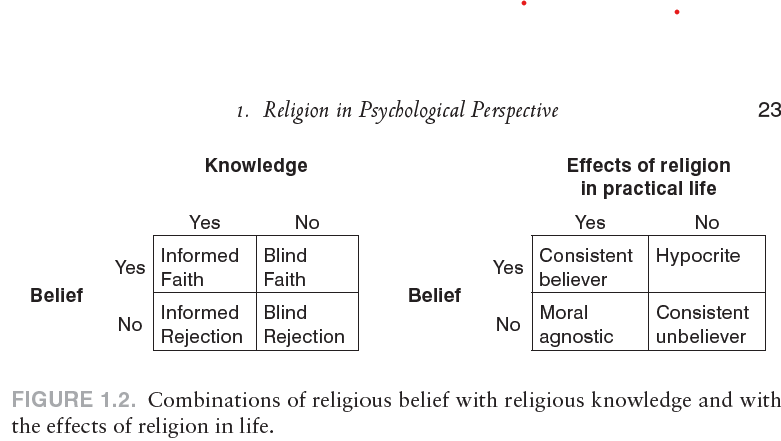
Dimensions of religiousness
- Believing (Personal religious beliefs - varying degrees of strength, Central or peripheral roles in a person’s life)
- Practice, rituals (the format of worship services, prayer, observance of special holidays or days of the week as sacred, fasting, and participation in sacraments)
- Feeling, experience (inner mental and emotional world of the individual, the sense of physical, psychological, and spiritual well-being that derives from believing)
- Knowledge, understanding (e.g. the history of manuscripts)
- Effects: Consequences (alcoholic who stops drinking shortly after a religious conversion, changes in family)