Roman Time, Christianity and Middle Ages
2025-11-28
Reminder
Three different roots, traditions:
Philosophical tradition (from Plato, Aristotle, St. Augustin, St. T. Aquinas…)
Physiological tradition, medical tradition (Hippocrates and Galen): interdependence/interchanges between body and brain, mind and soul
‘Hard-core’ science: physics, mathematics and statistics/data science
Western society, Christianity
- What was the major differences between concept of soul in Ancient Greek (Plato, Aristotle) and Roman time, Christianity?
- Concept of creation, God as creator, man as creature
- Genesis 1:27: “So God created man in his own image, in the image of God he created him; male and female he created them.”
Western society, Christianity
- Early church was embroiled not only with internal conflict, but in conflict with secular powers in Rome (King et al., 2016)
- Church doctrine in the Roman era departed from teachings attributed to Jesus of Nazareth
- Scholars point to discrepancies between attitudes toward women in the patristic church and attitudes displayed by Jesus
- Ignoring the prohibition, Jesus spoke to women even foreign women in public
- Jesus also accepted women as travel companions and included them in instructional activities.
- After ressurection: women come to the Jesus grave
Christianity and psychology
- Christianity: Christ the lord of psychology (Johnson, 1997)
- Important to understanding this relation: because of psychotherapy and counselling
- Because the rich and huge influence/relationship between development of the Western society and different disciplines and sciences
- In our course of history of psychology: usage of historical documents, scientific articles and important figures to understanding psychology of christianity
Christianity and psychology
- Most psychologists would argue that psychology and psychotherapy are disciplines or activities that are relatively neutral with regard to religious issues.
- Many have suggested in recent years, modern psychology and psychotherapy are not nearly as neutral or objective as is popularly assumed.
- They are historically-conditioned disciplines and sets of practices that have arisen within the last 100-150 years.
Christianity and psychology
- Modern psychology and therapy are simply modern versions of psychology and therapy
- Many of the major figures in early modern psychology were individuals raised more or less within Christian or Jewish families whose life journey involved a moving away from this religious orientation
- Including such notables as G. Stanley Hall, William James, John Dewey, J. B. Watson, B. F. Skinner, Sigmund Freud, Carl Jung, Karen Horney, Erich Fromm, Jean Piaget, Carl Rogers, and Abraham Maslow. (Johnson, 1997)
St. Thomas Aquinas (1225-1274)
- One of Aristotle’s most successful interpreters was the great Catholic theologian
- Aristotle thought was consistent with a Christian world view
- The idea of a Scala naturae (Great chain of being)
- “The universe is hierarchically arranged” with beings ordered “according to their internal perfection’’
- It is impossible to overestimate the importance to Western culture of this religious conception of the evolutionary process (Benjafield, 2015)
St. Thomas Aquinas (1225-1274)
Main features and tenets (Benjafield, 2015)
- Creatures are ordered hierarchically, reflecting God’s purpose.
- Nothing in this plan is “capricious” (that is, occurring merely by chance). Rather, everything and everyone has a place in a purposeful order that culminates in God.
- This view of nature is consistent with what we are told in the Bible, which is an irrefutable source of knowledge.
Lecture
Some of the important figures from Middle Ages
- St. Augustin (354-430)
- Evagrius Ponticus (345-399)
- John Cassian (360-435)
- Benedict of Nursia (480-547)
- Ibn Sina (Avicenna) (980-1037)
- Hildegard of Bingen (1098-1179)
- St. Thomas Aquinas (1225-1274)
Psychology during Middle Ages
- Theologians were interested in questions of desire, will, intention, sin and virtue
- Medieval thinkers resisted reducing the soul/mind to the brain while at the same time avoiding dualism.
- St Thomas Aquinas (13th century) - human as a compound of body and soul/mind.
Medieval time
Psychology can be understood as a development of Cartesian ideas about the separation of mind from body but what happened during medieval time?
- Hippocrates’ theory of the four humours (Galen, second century), idea of a mind–body continuum, for humours shaped both mind and body
- The distinction between mind and body was complex and more fluid than in post-Cartesian thought
- Complicated by ideas of the soul and connection between soul and spiritual world
- Integration of thought and affect (cognition and emotion).
post-Cartesian thought
Cartesian thought: proposes that true knowledge comes from reason and that the mind (thinking) is fundamentally separate from the physical body. post-Cartesian reject that
Rejection of dualism: A core tenet is the rejection of the mental-physical dichotomy
Philosophical and scientific approaches that emerged after René Descartes
Rejected ideas like mind-body dualism
The lost Millenium: Psychology during the Middle Ages (Henley & Thorne, 2005)
The medieval period - arround 1000 years
from the classical Greco-Roman age to the Renaissance
has long been neglected in the history of psychology
many history of psychology texts neglect the millenium that exists between Aristotle and Descartes
various reasons have been offered for why this period is treated so lightly
Psychology in the Dark Ages
almost every history of psychology textbook ignores over the thousand year period from Rome to the Renaissance
with the general argument being that medieval thinking, centered largely in theology, had put an end to scientific enquiry of all kinds
little-to-no interest in matters of philosophy beyond questions directly related to spirituality, and regarded the mentally ill as being possessed by the devil or witchcraft.
Thoughts are powerful
They have the capacity to enslave and control, to deceive, to blind, to make sick and to kill.
But they also have the capacity to set free, to empower, to illuminate, to heal and to bring life.
Thoughts have the power to deny prayer, and to enable prayer, to obscure God and to reveal God.
Philokalia
The Philokalia is an anthology of texts which are concerned with finding God within the human soul. The Eastern Orthodox compendium on mystical Christian prayer.
It is founded upon a philosophical tradition which draws upon Plato, Aristotle and the Stoics, and a Christian tradition which, beginning with the New Testament authors, continued through Clement, Origen and the early patristic authors, and found its first flourishing in the Desert Fathers.
The Philokalia was compiled as a “guide to the practice of the contemplative life”.
The Philokalia demonstrates that thoughts are powerful.
Philokalia - history and main figures
The hesychastic tradition, from within which the Philokalia emerged, has a long th history.
From as early as the 4 Century CE, the term “hesychia” was used by Christian monastic writers to refer to a state of inner quietness to be achieved in prayer as preparation for communion with God.
From the 6 to the 11 Centuries in the Byzantine world, a “hesychast” was simply a monk or ascetic, and hesychasm and referred simply to a broadly contemplative approach to prayer. In the 13 Centuries there was something of a spiritual revival, centred on Mount Athos, in which Gregory of Sinai (1258-1346) and Gregory Palamas (1296-1359) took a leading role.
This gave birth to a movement now known as the “Hesychast Tradition”, which drew upon traditions of Christian spirituality both from Syria and the Egyptian desert fathers.
- the story of Mount Athos (https://www.youtube.com/watch?v=gR78swqMz6Y)
The cloud of unknowing
- a 14th century classic by an anonymous writer
- a guide to spiritual experience
Power of thoughts
- Thoughts understood in a positive as well as a negative sense have distinct origins.
- To those coming from the senses, the memory, and temperament, are joined those which the angels and the demons prompt in us.
- If the human being gives his consent to the latter for everything depends on consent evil grows roots in us, and it becomes a “habitus” (habit) and then a passion (pathos) of the soul.
The philosophers: Psychology through antiquity and middle ages
There is scarcely a major topic in today’s textbooks of introductory psychology that was not anticipated, at least in rudimentary form, by the Greek philosophers (Hunt, 2009)
- Antiquity and Middle ages philosophers did not use the term “psychology” (did not exist until A.D. 1520, Marko Marulic… P. N. Castellani, G. Synnelius 1525.)
The philosophers: Psychology through antiquity and middle ages
Psychagogia - a psychotherapeutic method, counselling service that influencing behavior by suggesting desirable life goals. In a more spiritual context, it can mean guidance of the soul.
They use different distinct area of knowledge
They were questioned more fundamental the structure of matter and the nature of causality
Teleological explanation
- Psychology is often defined as the study of behaviour
- Teleological means (from the time of Aristotle) - causal explanation in terms of a practical justification
- The word “behaviour” is often used in an ambiguous way
- Behaviour refers to the movements that organisms make; other times it refers to their actions
Old and contemporary problems
Is there only one substance, or is “mind” something different from “matter”?
Do we have souls? Do they exist after the body dies?
How are mind and body connected? Is mind part of soul, and if so can it exist apart from the body?
Old and contemporary problems
Is human nature the product of inborn tendencies or of experience and upbringing?
How do we know what we know? Are our ideas built into our minds, or do we develop them from our perceptions and experiences?
Old and contemporary problems
How does perception work? Are our impressions of the world around us true representations of what is out there? How can we know whether they are or not?
Which is the right road to true knowledge—pure reasoning or data gathered by observation?
What are the principles of valid thinking?
What are the causes of invalid thinking?
Does the mind rule the emotions, or vice versa?
Why go back to Middle Ages?
- Engagement with questions of mind, body and affect
- Development of deep and sophisticated thinking throughout experience and introspection about psychology
- Medieval texts open onto a psychology that was not dominated, as many recent discourses are, by essentially Cartesian notions of mind–body dualism.
- Before Descartes, mind and body are very close to modern flavour!
Psychology during Middle Ages
- Theologians were interested in questions of desire, will, intention, sin and virtue
- Medieval thinkers resisted reducing the soul/mind to the brain while at the same time avoiding dualism!
St Thomas Aquinas
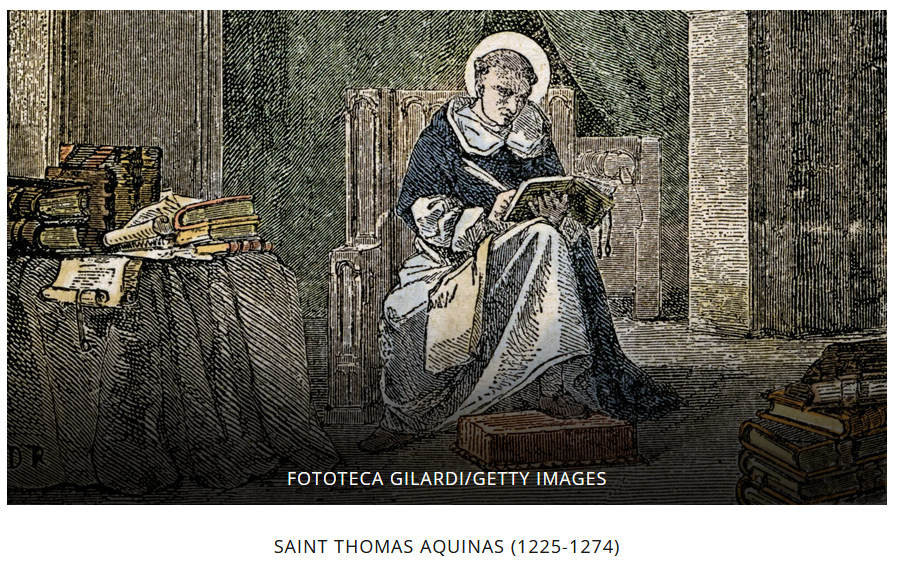
St Thomas Aquinas
- St Thomas Aquinas (13th century) - human as a compound of body and soul/mind.
- Revisited the list of seven deadly sins in Summa Theologica (“Summary of Theology”). Sin cause other sins by way of final causality!
- In his list, he brought back “sloth” and eliminated “sadness.”
St Thomas Aquinas
- The Catechism of the Catholic Church’s current capital sins are basically the same as Aquinas’, except that “pride” replaces “vainglory.”
- Aquinas follows Gregory consistently and closely regarding the capital sins (habits). He lists the seven as vainglory, envy, anger, avarice, sadness, gluttony, and lust.65
The Seven Deadly Sins
- Christianity (according to Church Fathers) identifies them as pride, avarice, envy, wrath, lust, gluttony, and sloth or acedia.
- Dante names them as pride, envy, wrath, sadness, avarice, gluttony, and luxury in his Purgatorio.
The Eastern Church Fathers: The Evil Thoughts
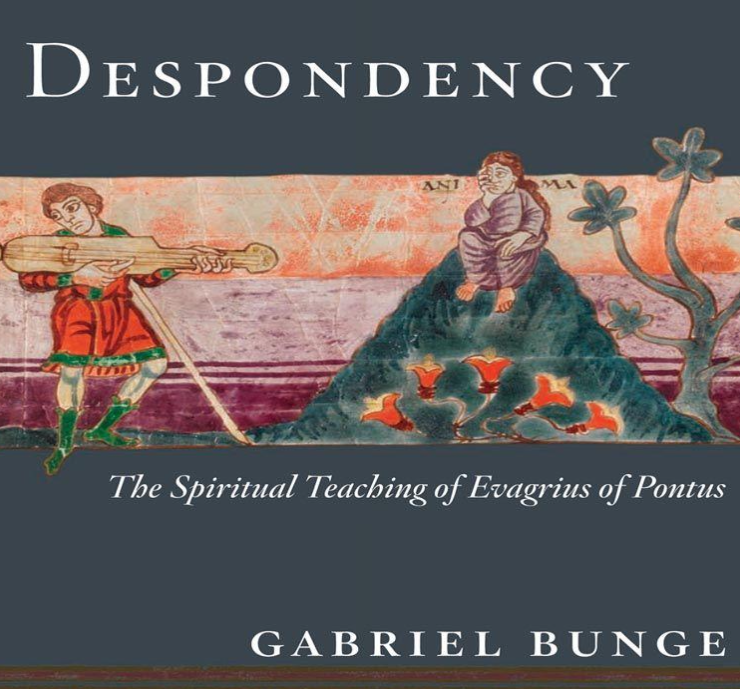
- Evagrius of Pontus (ca. 345–99) - spiritual master of the monastic life
- Evagrius focuses on the practical life of asceticism, a sort of spiritual combat that the monk must win in order to grow in virtue.
- There are eight general and basic categories of thoughts in which are included every thought.
- First is that of gluttony, then impurity, avarice, sadness, anger, acedia, vainglory, and last of all, pride.
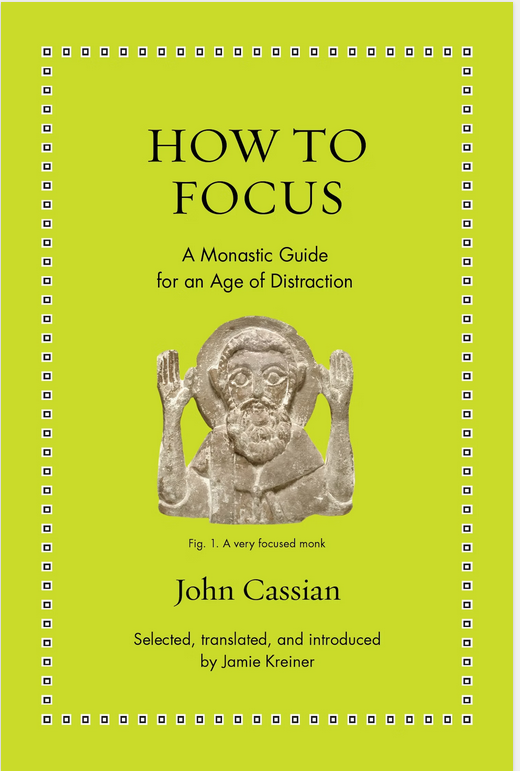
John Cassian (360–ca. 435)
- John Cassian who brought the doctrine of the capital vices into the West in the early fifth century
- Cassian lists gluttony (gastrimargia), fornication (fornicationis), covetousness (philargyria), anger (ira), sadness (tristitia), acedia (acedia), vainglory (cenodoxia), and pride (superbia).
- The only difference between the Evagrian list and the Cassian one is the ordering of anger and sadness.
- Self-Attention in Evagrius Ponticus: A Specific Modality of Self-Regulation of Attention as a Way of Self-Knowledge (Gargiulo, Vazquez 2022)
Vainglory/Pride
- “Vainglory is kind of like that vice that makes us check our ‘like’ counts on social media,” (Clarke & Aquilina (Foreword), 2018)
- “Vainglory is where we seek human acclaim.” In contrast, “pride is a sin where I essentially take spiritual credit for what I’ve done,” instead of “ascribing one’s good deeds to God.”
The Seven Deadly Sins
- The seven deadly sins were a popular motif in medieval art and literature
- Persist as a concept through the centuries
- The movies Se7en (1995) and Shazam (2019) both deal with the seven deadly sins.
Se7en (1995)
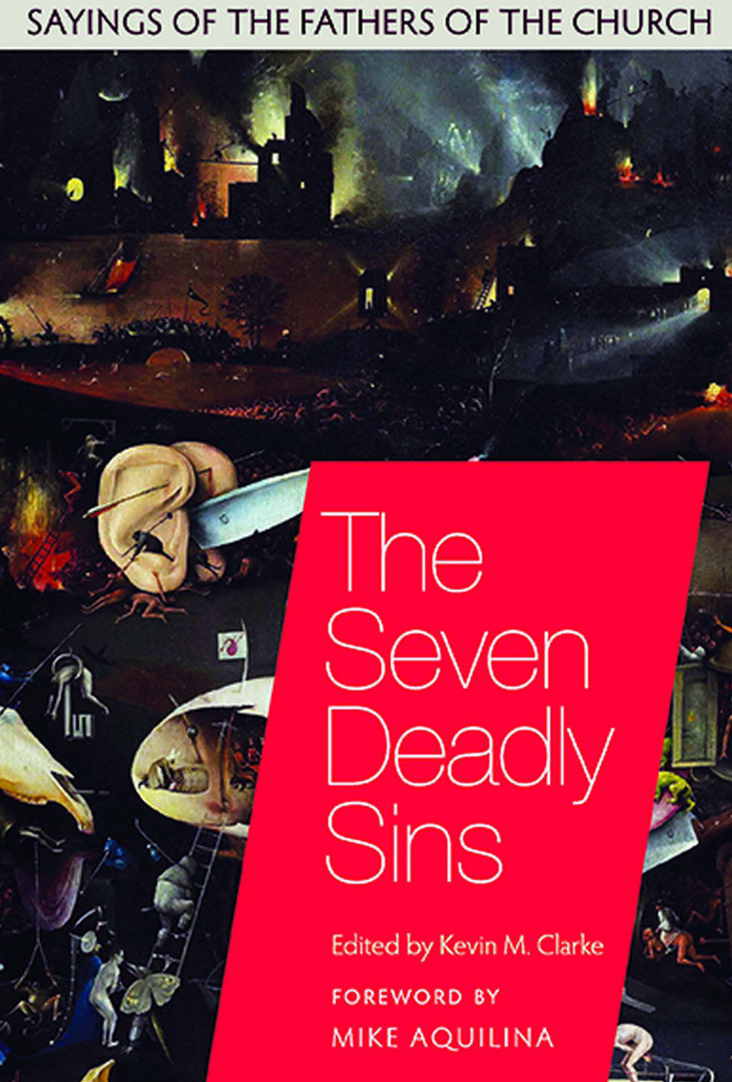
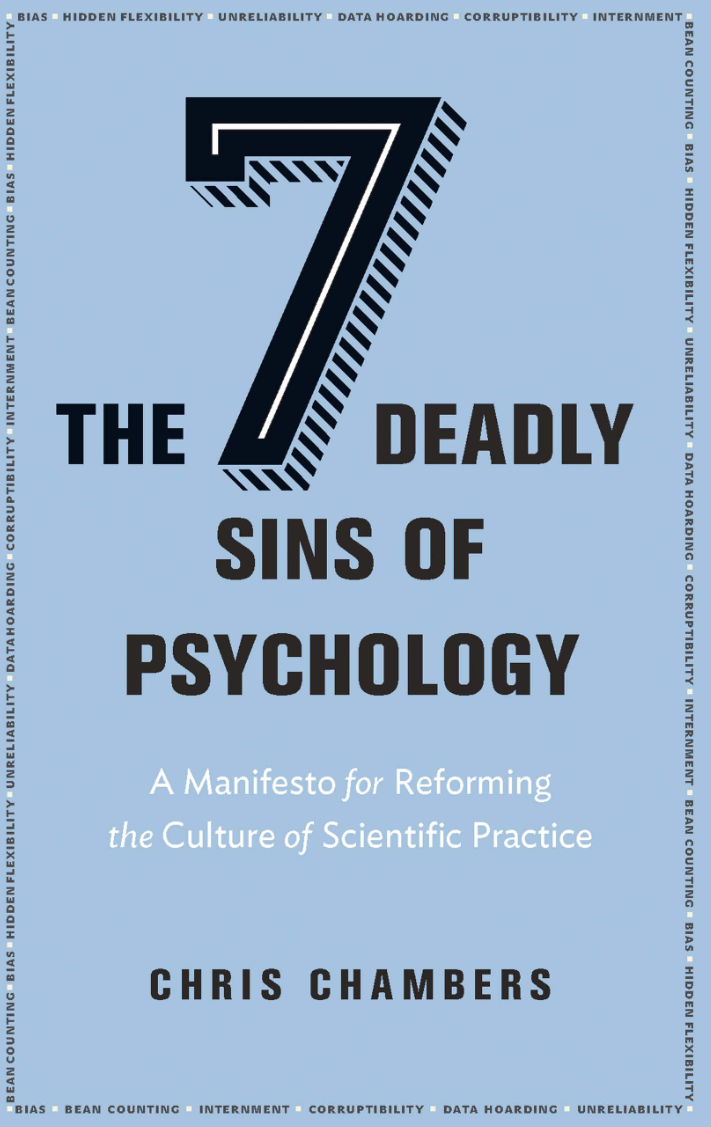
The Seven Deadly Sins (Clarke & Aquilina (Foreword), 2018)
Medieval time
Psychology can be understood as a development of Cartesian ideas about the separation of mind from body but what happened during medieval time?
- Hippocrates’ theory of the four humours (Galen, second century), idea of a mind–body continuum, for humours shaped both mind and body
- The distinction between mind and body was complex and more fluid than in post-Cartesian thought
- Complicated by ideas of the soul and connection between soul and spiritual world
- Integration of thought and affect (cognition and emotion).
Go back and compare
- Aristotle had situated the rational or intellective quality within the soul, and had located the heart as the centre of the senses and cognitive faculties
- Galen associated these with the brain.
Go back and compare
- Neo-Platonic theories situated the immortal and rational part of the soul in the head, and the appetites and emotions in the trunk of the body.
- St Augustine (fourth century) saw the will as a faculty of the (superior) soul and associated emotions with the (lower) body, but also saw emotions as having both cognitive and bodily aspects (kemp1990?)
Inner senses
The scholastic theory of the Inner senses can be viewed as an attempt to explain and classify cognitive abilities based on anatomy and physiology of brain:
- the concept of the inner senses is rooted in Aristotle’s (384–322 BCE) remarks on postsensory faculties of the soul in the second and third books of De Anima and in De memoria et reminiscentia.
- A model listing three “inner” psychic faculties, assigned to three cerebral ventricles (imagination/front ventricle, intellective faculty/middle ventricle, memory/rear ventricle)
Inner senses
- Galen (129–c. 199) via Nemesius’s (fourth century AD) De natura hominis
- John Damascene’s (c. 675–749) De fide orthodoxa
Inner senses
- St. Augustine (354–430) was the first to use the Latin term sensus interior, meaning Aristotle’s common sense (Confessions)
- St. Thomas Aquinas (1225–1274) calls the common sense the “root and principle” of the external senses
- Aquinas’s fourfold list of inner senses (Summa Theologiae): imagination (imaginatio sive phantasia ), the functioning as storage for sensible forms, the estimative power (vis aestimativa ), and the memory (vis memorativa, memoria sive reminiscentia ).
Cognition in medieval texts
Ancient and medieval writers on memory recognized, as we now do, the dual aspects of storage and recollection involved in remembering (carruthers2002?)
Four humours
Balance and dynamic interplay of the cerebral faculties:
- connection of bodily humours end emotions
- Hippocrates (460 B.C - 377 B.C.) humors theory is the most influential theory in the medicine before modern age
- blood (corresponding to fire), phlegm (corresponding to water), black bile (corresponding to earth), and yellow bile (corresponding to air)
Four humours
- Galen (129 A.D. to 217 A.D.) suggested that our dreams could also be used as indicators of which humors were in excess or shortage
- The theory of the inner senses would remain the dominant theory of cognitive functioning until the mid-sixteenth century whereas the humors theory continued to be widely accepted through to the late eighteenth century (17thstreet2013?)
Concepts of cognitive processes
- memoria as universal thinking machine (carruthers2002?)
- technology for meditation incorporating emotions, memory and motivation
- spatial rather then temporal properties of memory representation
- soul, mind, intellect,thought, emotion, affect, senses and body - all intimately connected in medieval thinking
Emotions in medieval thinking
- Medieval texts - interdependence of mind and body, cognition and affect with awareness of the supernatural; God and devil, angels, demons and ghosts (Sounders, 2016)
- for contemporary neuroscientists: the cognitive is always emotional and emotional is always cognitive
- Emotions plays a critical role in virtually all aspects of learning, reasoning, and creativity. Finaly, it may play a role in the construction of consciousness (damasio2004?)
Emotions in medieval thinking
- Emotions could be produce from something out there
- E.g. state of melancholy: subject loses the ability to judge and reason
- In that example emotion and cognition are interdependent
- What happened in the body: front ventricle - phantasia after that problems with imagination and judgement in the middle ventricle
- Some modern theories about emotions staying into the trap of reductionism
At the end of medieval period (12th, 13th century)
- Avicenna, Thomas Aquinas, Albertus Magnus and Roger Bacon developed complex theories of mind
- Observations of the effects of head injuries had confirmed Galen’s view that the rational aspects of the psyche were located in the brain
- that persists through the Middle Ages and beyond of the heart as the site of understanding and feeling
At the end of medieval period (12th, 13th century)
- The main work was done by the cerebral ventricles, which housed the ‘inner senses’: from the external senses and constructing thoughts from their component concepts or ‘forms’ (imagines or phantasmata).
- Aristotle’s theory: mental processes were housed in organs of the body vs. Galen proposed that memory was in the cortex of the brain.
De spiritu et anima
- Cistercian monks (Alcher of Clairvaux was a twelfth-century Cistercian monk of Clairvaux Abbey) and the regular canons of Saint-Victor dialogue between affective spirituality and speculative thought.
- As proof of this, one of the most popular thirteenth century sources concerning psychology was an anonymous treatise, mostlikely written by a Cistercian in the 1170s entitled De spiritu et anima.
- This text offered an impressive synthesis and was quickly attributed to Saint Augustine.
De spiritu et anima
- The purpose of this monastic reflection on the nature of the soul remained aligned with the project of Augustine as corrected by Anselm of Canterbury at the end of the eleventh century a synergy between the science of man and his spiritual destiny by combining the philosophical reflection on the powers of the soul with a spiritual perspective. (Boquet & Nagy, 2016)
- The most important contribution of the Cistercians to medieval anthropology was the integration of affectivity into the classification of the powers of the soul.
- Some questions about the origins of De spiritu et anima (Mews, 2018)
De spiritu et anima
Higher Self – Spark of the Mind – Summit of the Soul: Early History of an Important Concept of Transpersonal Psychology in the West (Walach, 2005)
Detail explanation the roots of psychology of personality and psychotherapy in the writings of monastic experiences during 12th Century
Thomas Aquinas
- The great mediaeval synthesis of knowledge was made by Thomas Aquinas!
- In psychology he occupies the middle ground between Augustine and Aristotle, maintaining that the soul possesses reason and will in its own right, while the sensitive and vegetative faculties belong to it as the form of the body.
Thomas Aquinas
- The keynote to Thomistic metaphysical psychology is the essential distinction between a lower or sensuous, and a higher or rational grade of consciousness (Botkin, 1921).
- Aquinas distinguishes between two types of cognition: sensory cognition and intellective cognition (Dryden, 2016). Sense gives us knowledge of the particular and contingent, intellect gives us knowledge of realities, substantial or accidental, by means of abstraction.
Thomas Aquinas
- While it is not clear whether there is perfect correspondence between the concept of emotion and the concept of passion, there still seems to be significant overlap.
- Passions have concrete particular intentions as their object, involve bodily change (flushing of the face in anger, shaking in fear, etc.), have a feeling element, and are not within our direct control.
Affectus
- Affectus and affectio, however we translate these words, became key concepts in Cistercian thought in the twelfth century.
- The figure most well-known for theorizing affectus in the sense of inclination or what in German is called Affekt least in terms of friendship
Affectus
- Deserving particular attention are two treatises about the soul, the De anima of Isaac of Stella (c. 1100–1169), in which he says he is responding to questions raised by his friend Alcher
- and the De spiritu et anima, a text which expands on Isaac’s Platonizing ideas about the soul with arguments indebted to Augustine. 3 While the De spiritu et anima (hereafter DSA) would be widely circulated in the thirteenth century as a work of Augustine, about both reason and affectus in the soul. The DSA was much more influential than Isaac’s treatise in the thirteenth century in reformulating Augustinian thought about both reason and affectus prior to the impact of Aristotelian thinking about the intellective soul. (Mews, 2019)
Unbounded potentital of the monastic mind
https://themarginaliareview.com/demons-and-western-psychology-the-unbounded-potential-of-the-monastic-mind/
Inbar Graiver: Asceticism of the Mind (knjiga)
John Cassian
Dangerous Passions, Deadly sin (Okholm, 2014)