Hystory of Abnormal Psychology
We cannot understand contemporary psychology without first researching its history (Sternberg & Pickren, 2019)
Understanding history of AP
- history of disorders and treatments
- history of clinical psychology
- history of psychiatry
The Greeks and Romans
- held a naturalistic view of man
- viewing disease as malfunction of the body (physis)
- without personal responsibility.
- In the Hellenistic world two opposed trends emerged: the rationality of Neoplatonism and the irrationality of astrological, neo-Pythagorean, and Eastern religious beliefs.
Influences of the Greeks and Romans
- Hippocrates (humors of the body + environmental factors)
- Galen
- Plato (soul is most important, dreams also)
- Aristotle (according to Plato)
- Myths (the belief that moon has a major impact of human behaviour)
Old Testament
- Hebrew tradition
- Madness caused by disobedience to God’s commands
- Departure of the spirit of the Lord or to possession by an evil spirit (Deut. 28, 28).
New Testament
New concept of man consisting of the three tenets;
- the psychological and moral inner life of the individual;
- the essentially otherworldly nature of man
- the emphasis on love (caritas, rather than the Greek concept of Eros) in human relations
Disease in NT
Three distinct kinds of reference to disease and medicine (Mora, 2008)
- metaphorical references
- literal reference
- didactic reference
- Christ a healer of spiritual and physical disorders: blindness, paralysis, possession by demons, and waking up someone from death
Focus of Christ message
- Forgiveness by Christ of all sins
- Moral obligation to care for the sick
Posidonius (4th CE)
- The Greek physician Posidonius probably the first physician to concern himself mostly with psychiatric disorders
- Closely studied brain diseases. The first person to attempt to localize brain functions, he tied imagination, understanding, and memory respectively to the anterior, median, and posterior brain ventricles,
- An idea that was accepted for centuries, probably due to its analogy with the classical tradition’s triadic division of the soul.
The Monastic Period
- waves of invasions of Rome in the fifth and sixth centuries
- St. Benedict founding the mnastery of Montecassino in 529.
- After that: the others St. Columban, St. Gall, Lisieux, Montserrat….
- Seven deadly sins and importance of thoughts (Cassian)
- Medical encyclopedias (Isidore of Seville, 7th CE): mania, melancholica, phrenitis, incubus or nightmare…
History of clinical psychology
- began in the late 19th century
- 1896, Lightner Witmer (received doctoral degreee under Wundt)
- L. Witmer founded a psychological clinic at the University of Pennsylvania and start to training psychologists in the clinical method
- The Clinical Method of Psychology and the Diagnostic Method of Teaching - established clinical psychology
- There were only about 200 psychologists in the US (few numbers of them were clinicians)
Clinical psychologists
- arround 1980 - 1985
- Clinical psychology in over of 100 universities and 43 professional schools
- One hundred thousand psychological personnel and more than half (68,148) were involved in mental health service (Stapp, Tucker & VanderBos, 1985 according to (Reisman, 1991))
1890 to 1899 (Reisman, 1991)
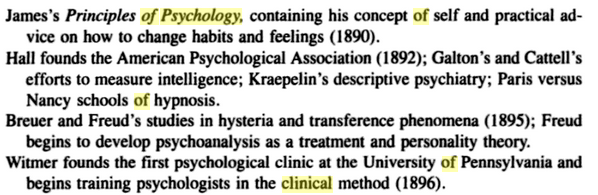
1900 to 1909 (Reisman, 1991)
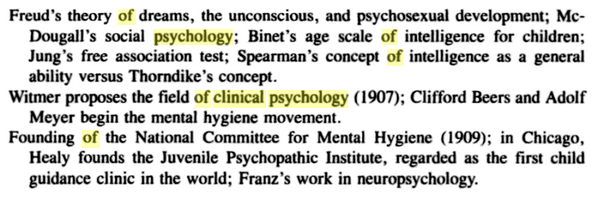
Roots (Reisman, 1991)
- 18th century British empiricism and Rousseau’s antithesis (Feelings and natural expression are superior to reason and reflection; people are harmed by their environment and class distinctions)
- Pinel’s moral treatment and beginnings of scientific psychiatry (1793)
- Itard’s training of the Wild Boy of Aveyron (1800)
- New Jersey building a hospital for the mentally ill (1848)
- Darwin’s theory of evolution (1859)
- Wundt’s scientific psychology (1879)
Pierre Marie Félix Janet
- 1859 - 1947
- French psychologist, physician, psychotherapist
- coined the words dissociation and subconscious, transference phenomena
- He coined that terms according to uncosnciousness before Freud
Emergence of Psychiatry
- In 1799. a young boy of 11 or 12 was captured in the woods of Aveyron (France)
- He could not speak and appeared to be a child of nature
- Pinel was called upon to examine the boy and diagnosed him as an idiot
- French government appropriated funds to enable Jean Itard, a physician to educate the Wild Boy of Aveyron
- After five years Victor was not able to talk
- After that Edward Seguin (1837) establish the first school for retardates in Paris
Franz Joseph Gall (1758-1828)
- Comparative brain anatomy,
- Significance of the cortex,
- White and gray matter in the nervous system,
- Commissures connected the brain hemispheres
Pierre Paul Broca (1824 - 1880)
- Was a French physician, anatomist and anthropologist.
- Broca area, Broca aphasia: he found the area of the cortex associated with speech
- Discovered the chloroform in anesthesia,
- Managing methods during surgery: hypnosis and carbon dioxide as a local anesthetics
Philippe Pinel (1745-1826)
- a French physician, precursor of psychiatry
- contributions to the classification of mental disorders
- precursor of mental disorder later known as dementia praecox or schizophrenia
The Rise of Psychiatry and abnormal psychology
- psychiatry as a distinct medical discipline started developing from the 18th century
- psychiatry - medical treatment of the soul (from Ancient Greek psykhē ‘soul’; -iatry - medical treatment from Gk. iātrikos medical from iāsthai to heal)
- term cointed 1808 by Johann Christian Reil (1759-1813)
- importance of Sigmund Freud
- Edward Livingston Youmans founded 1872 Popular Science Monthly with featured articles about abnormal psychology. He was influenced by Herbert Spencer.
- James McKeen Cattel the famous psychometrics was editor-in-chief at 1900. and also the president of Americal Psychological Association
- 1906 inaugural issue of the Journal of Abnormal Psychology
The Ascent of Psychiatry (1800-1945)
- emergence of multiple dimensions of mental conditions
- multidimensionality of modern thought about abnormal mental conditions starts
- Karl L. Kahlbaum, German psychiatrists, 1888 - called for the meaningful classification of mental illnesses
- Emil Kraepelin - encouraged by his teacher Wilhelm Wundt (founder of the first lab) to developed classification… nine editions from 1883 - 1926.
- psychoanalitic revolution 1891-1950: the psychological basis of mental disorders!
- Ernst Kretchmer 1921 - relationship between physical type and temperament
The origin of melancholy
- The Anatomy of Melancholy published 1624, Robert Burton (1577-1640): the most famous work
- Anatomy shows, melancholy can arise from a wide variety of causes. Bad diet, one’s parents, education, too much sex or not enough, witchcraft (Lund, 2010)
- greatest interest and importance for Burton’s contemporaries (Thomas Wright as the best-known writer on the passions, Levinus Lemnius and Timothy Bright)
- psychological and spiritual aspects of the disease
- sin as the root of melancholic suffering
- passions, which are ‘certain internal acts or operations of the soul’, are so called because ‘when these affections are stirring in our minds they alter the humours of our bodies, causing some passion or alteration in them’ (Lund, 2010)
Categories of melancholy
Burton described three categories of melancholy (Plante, 2013)
- head melancholy — brought about inwardly by excessive passions and im- balanced humors, an adjust humor, disease, or excessive or deficient sexual activity; and outwardly by a heat stroke, a blow on the head, hot wines, exces- sive spices, lack of sleep, idleness, loneliness, and excessive study or work.
- hypochondriacal or windy melancholy — involving imbalance in the digestive system, affecting the spleen, belly, stomach, and bowels.
- whole body melancholy — brought about by an imbalanced diet, distempered liver, or excessive worry.
Depression
- The rise of market-driven economies creates a breakdown of social support mechanisms and of the sense of community.
- People lose their feeling of being connected to social groups and so feel depleted and solitary.
- Deprived of resources, economically unstable, subject to acute pressures
- The causes of depression, according to this view are social. (Leader, 2009)
Depression
- Historians of psychiatry and psychoanalysis have mostly agreed that depression was created as a clinical category by, a variety of factors in the second half of the twentieth century:
- The market for minor tranquillizers collapsed in the 1970s after their addictive properties were publicized and so a new diagnostic category - and remedy for it had to be popularized to account for and cater to the malaise of urban populations
Depression
- new laws about drug-testing favoured a simplistic, discrete conception of what illness was.
- As a result, drugs companies manufactured both the idea of the illness and the cure at the same time. Most of the published research had been funded by them, and depression came to stand less for a complex of symptoms
- If the drugs affected mood, appetite and sleep patterns, then depression consisted of a problem with mood, appetite and sleep patterns. Depression, in other words, was created as much as it was discovered. (Leader, 2009)
Depression
The idea of depression as a brain problem retains its attraction even for the sceptics. When newspaper articles point to the dangers of particular drugs like Seroxat, suggesting that they increase the risk of suicide, the reasons for this are then explained biochemically
The myth of depression as an exclusively biological disease has come to replace the detailed study of the variety of human responses to loss and disappointment (Leader, 2009)
In Britain, the drugs industry is the third most profitable economic activity, after tourism and finance.
Depression, melancholia
- To treat a depression on the same model as, say, an infection requiring, antibiotics is always a dangerous decision (Leader, 2009).
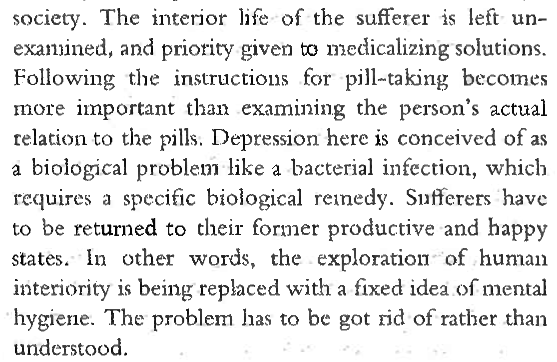
From the book The New Black: Mourning, Melancholia, and Depression (Leader, 2009)
Psychosomatic
- Johann Christian August Heinroth (17 January 1773 – 26 October 1843) was a German physician and psychologist who was the first to use the term psychosomatic.
- Heinroth was born in Leipzig and he became a lecturer at the University of Leipzig, a full professor of physical medicine.
- He believed that the soul had primacy over the body and because of that mental disorders and many somatic illnesses are caused by the soul (precisely by sin).
Psychosomatic
- Heinroth did not regard sin as a singular event, but rather as a life conducted in a wrong way for years or even decades, by which he meant a steady striving towards earthly, bodily satisfaction. (Steinberg, 2004)
- Personality divided into three personality types: the Uberuns (conscience), the Ich (mind, emotions and will) and the Fleish (basic drives, which included man’s sinful nature).
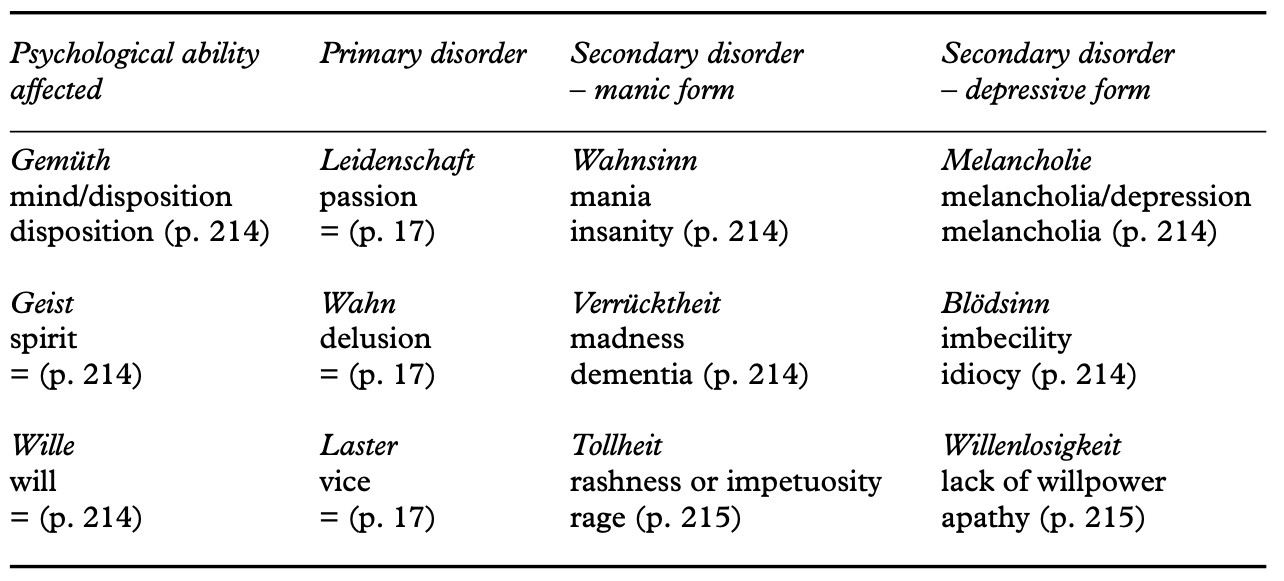
Heinroth, (1810), pp. 235–344; (1818), pp. 35–43
Psychosomatic
- Illness, desease, and spirituality (Beck, 2007)
- Combining theological and medical perspectives is indispensable for the historical study of the interconnections between mind, body, and soul. (Hyrkäs, 2023)
- Finland-Swedish theologian turned psychiatrist Asser Stenbäck (1913–2006). Stenbäck’s career, which evolved from priesthood to psychiatry and politics, reveals a great deal about the tensions between religion and medicine, how health and Christian morality were interconnected.