Natural science, Empiricism and Metaphysics
What happened during 18th centuries
Goran Kardum
- During the eighteenth century, as in the seventeenth, “psychology” was the science of mind or soul. or of mental phenomena; as such, it was known under many names, deriving from “psyche”, “anima”, “soul”, “mind”, and their cognates.
- Christian Wolff place the psychology under the rubric of metaphysics rather than physics (Vidal, 2000)
- By mid-century, psychology in Germany was primarily empirical, and was the object of numerous publications; sometimes called Erfahrungsseelenlehre, it had object of numerous publications; it had moved from metaphysics to the “science of man” that prospered under various names (Menschenkunde, Menschenlehre).
Christian Wolff
- Eminent German philosophers between Leibniz and Kant. A key figure of the German Enlightenment.
- Christian Wolff was a prominent German philosopher, mathematician, and jurist
- Born: January 24, 1679, Wrocław, Poland
- Died: April 9, 1754, Halle (Saale), Germany
- The Ground Zero of Modern Psychology? (Klempe, 2020)
Christian Wolff
- Wundt often refers to Wolff, and Wolff must therefore be seen as a prerequisite for psychology
- Wolff creating the foundational distinction between (based on experience/introspection) and (based on reason)
- Establishing psychology as a distinct field seeking scientific laws for the soul
- Psychologia empirica (1732)
- Psychologia rationalis (1734)
- Psychology as independent science and also experience-based science
Wolff definition and influence
- Discursus praeliminaris Wolff defines psychology: “That part of philosophy which treats of the soul, I call psychology. Thus psychology is the science of whatever is possible through human souls”
- Impact to Kant: A Wolff in Kant’s Clothing: Christian Wolff’s Influence on Kant’s Accounts of Consciousness, Self-Consciousness, and Psychology (Dyck, 2011)
- In the Empirical Psychology, Wolff’s analysis of consciousness revolves around three fundamental concepts: thinking (cogitare), perceiving (percipere) and apperceiving (appercipere) (Sala, 2024)
Immmanuel Kant (1724-1804)
- Kant position: psychology as a systematic but inherently limited discipline, focusing on inner experience (Critique of Introspection)
- He proposed a faculty psychology (cognition, feeling, willing) and argued the mind isn’t a blank slate but organizes the world into phenomena (how things appear) versus the unknowable noumena (things-in-themselves)
- Significantly influenced modern cognitive psychology, especially concepts of mental frameworks (schemata) and the foundation for cognitive therapies
Immanuel Kant
- Psychology, or Anthropology, as Kant would prefer to call it is wholly empirical but it could never be a science
- Kant argued because mental phenomena are in the flux of time and therefore incapable of measurement.
- Phenomena vs. Noumena: We only experience the world as it appears to us (phenomena), filtered by our minds, not the world as it is in itself (noumena).
- Reason is the source of morality
Influence to…
- Cognitive Science: His idea of the mind as an organizer of sensory input laid groundwork for cognitive psychology and concepts like schemas (J. Piaget).
- Cognitive Therapies: “Kantian spectacles” concept—that reality is filtered through cognitive templates… foundational to therapies like CBT (Aaron Beck) and REBT (Albert Ellis).
Ferdinand Ueberwasser
- (1752–1812)
- Jesuit novice
- Philosopher, metaphysicist, and psychologist
- 100 years before Wilhelm Wundt talks about empirical and independent scientific discipline (Schwarz & Pfister, 2016)
- Ueberwasser’s (1787) Instructions presents an extensive, structured approach to empirical psychology.
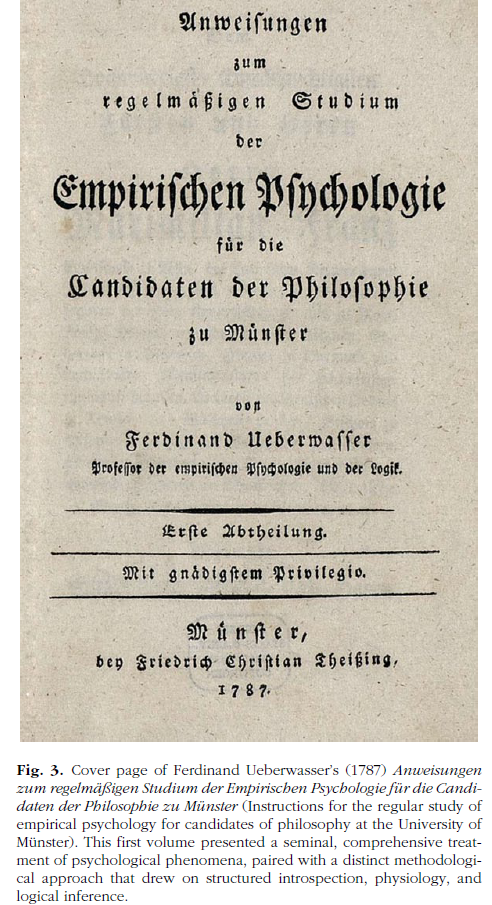
- Should we pre-date the beginning of scientific psychology to 1787? (Pfister & Schwarz, 2018)
Gnothi Sauton
- Karl Philipp Moritz’s Gnothi Sauton (Greek for “Know Thyself”) was a pioneering German journal (1783–1793)
- Focused on empirical psychology, featuring case studies of mental and nervous disorders
- A journal, Gnothi Sauton oder Magazin zur Erfahrungsseelenkunde (Journal of Empirical Psychology), the first of its kind
Gnothi Sauton
- Content: Detailed accounts of epilepsy, dementia, aphasia, and other conditions… focusing on disturbances of language and consciousness (Forstl, 1992)
- Significance: a shift from literary interest to empirical science in studying the mind, providing a model for future psychological journals.
- Impact: Case materials were translated and influenced later psychiatric thought.
Authors, theories, and events in the 18th century had their own incredible influence on authors and theories of the 19th century
This is especially true of the tension between empiricism and metaphysics
Predecessors of Wundt
- Psychophysicists Ernst Heinrich Weber (1795–1878) and Gustav Theodor Fechner (1801–1887) mathematical tools in the study of the human mind.
- Neuroanatomists Paul Broca (1824–1880) and Carl Wernicke (1848-1905): physiological approach to understanding the human mind, and integrative work
- Philosophers such as Johann Friedrich Herbart (1776–1841) and Rudolf Hermann Lotze (1817–1881): theoretical frameworks and structured understanding of psychological phenomena.
Ernst Heinrich Weber (1795–1878)
- A pioneer of psychophysics, formulating the concept of the just-noticeable difference (JND) and what became Weber’s Law
- Quantifying how stimulus perception relates to physical intensity
- It states that the just-noticeable difference between two stimuli is a function of the magnitude of the original stimulus
- He came to the conclusion that the intensity of a sensation increases with the logarithm of the intensity of the stimulus (Weber-Fechner’s psychophysical law)
- He discovered the inhibitory action of the vagus nerve on cardiac action, and measured the velocity of blood flow.
Gustav Theodor Fechner (1801–1887)
- Gustav Theodor Fechner (1801–1887) is one of the most enigmatic thinkers of nineteenth century German philosophy (Stanford Encyclopedia of Philosophy)
- On the one hand, Fechner had deep positivist proclivities, which made him advocate the strictest standards of observation and measurement in science
- On the other hand, Fechner also had a desperate longing for metaphysics, for a complete vision of the entire cosmos, which his piecemeal scientific work could never satisfy.
- Fechner was a pioneering theorist of the unconscious mind
Fechners works
- Zend-Avesta is Fechner’s most personal work
- Fechner’s natural religion was decidedly not Christianity (denial of a transcendent dimension beyond nature)
- His insistence that the mental be embodied in the physical (he believed in panpsychism)
- Panpsychism is the philosophical view that mind or consciousness is a fundamental, universal feature of reality, present in everything from subatomic particles
- Major contribution to psychology was founding Psychophysics (Mind-Body connection), an experimental approach to quantify the relationship between physical stimuli and subjective mental sensations
- His own religion as a synthesis of Christianity and paganism (Fechner 1879: 71 cited by SEP)
References
Dyck, C. W. (2011). A wolff in kant’s clothing: Christian wolff’s influence on kant’s accounts of consciousness, self‐consciousness, and psychology. Philosophy Compass, 6(1), 44–53. https://doi.org/10.1111/j.1747-9991.2010.00370.x
Forstl, H. (1992). Neurologic disease described in the journal of empirical psychology (gnothi sauton oder magazin zur erfahrungsseelenkunde), 1783-1793. Archives of Neurology, 49(2), 187–188. https://doi.org/10.1001/archneur.1992.00530260089026
Klempe, S. H. (2020). Tracing the emergence of psychology, 15201750: A sophisticated intruder to philosophy. Springer International.
Pfister, R., & Schwarz, K. A. (2018). Should we pre-date the beginning of scientific psychology to 1787? Frontiers in Psychology, 9. https://doi.org/10.3389/fpsyg.2018.02481
Sala, L. (2024). Wolff’s theory of consciousness, re‐examined. European Journal of Philosophy, 33(3), 871–889. https://doi.org/10.1111/ejop.13037
Schwarz, K. A., & Pfister, R. (2016). Scientific Psychology in the 18th Century: A Historical Rediscovery. Perspectives on Psychological Science, 11(3), 399–407. https://www.jstor.org/stable/26358629
Vidal, F. (2000). The Eighteenth Century as "Century of Psychology". Jahrbuch Für Recht Und Ethik / Annual Review of Law and Ethics, 8, 407–434. https://www.jstor.org/stable/43579329