Theories and structure of Consciousness
Goran Kardum
Department of Psychology, room: 228, gkardum@ffst.hr
Intro
- Before psychological science was founded, consciousness was originally a purely philosophical problem (Revonsuo, 2017)
- Philosophers also take into consideration the potential limitations of human science and consciousness could not ever be solved
- Traditionally known as the mind–body problem, or the brain-consciousness problem.
The philosophical foundations of consciousness science
- Dualism
- Monism (many forms)
Questionnaire (15 minutes)
- Conceptions about the mind-body problem (Riekki et al., 2013)
- Assessment of the mind-body connection (Van Bael et al., 2023)
Dualism
- two fundamental types of stuff
- the physical stuff (matter and energy)
- the mental, non-physical stuff (spirit, mind, consciousness, thought)
- Modern science tell us nothing about consciousness
Monistic
- assume that the world consists of only one fundamental type of stuff
- all the different things in the world are derived from this one fundamental substance
- Monism is divided into different varieties: believed in the nature of this one fundamental substance
Monistic theories
- monistic materialism or physicalism
- neutral monism
- idealism (mental monism)
Monistic materialism or physicalism
- Everything in the world consists of physical phenomena
- If everthing is physical than also consciousness must be a physical phenomena
- Atom, molecules, quantum physics
- Stanovich - dualism scale… 20 minutes, student fill out…
Lecture
- How does consciousness relate to physical matter? Bodies, brain, biologica processes?
- The fundamental matter or nature of consciousness?
- The nature of soul, mind, and consciousness?
Dualism
- two fundamental types of stuff
- the physical stuff (matter and energy)
- the mental, non-physical stuff (spirit, mind, consciousness, thought)
- Modern science tell us nothing about consciousness
Monism
- one fundamental type of stuff
- Monistic materialism / physicalism
- Neutral monism
- Idealism (mental monism)
- Neorealism
Soul or consciousness
- One of the most common objections to the existence of souls is the problem of explaining how something that is non-physical (i.e. a soul) could possibly cause physical things (i.e. a body) to move.
- But…
- A magnetic field can move a tack, gravity can act on a planet millions of miles away, protons exert a repulsive force on each other and so forth. (Kupisz, 2019)
- The anatomic location of the soul from the heart, through the brain, to the whole body, and beyond (Santoro et al., 2009)
Dualism
- Spiritual ghosts trapped in the material machinery of body and brain (Revonsuo, 2017)
- Philosophical tradition (Plato), traditional and religious beliefs
- Rene Descartes (1596-1650) Cartesian dualism, Interactive dualism
- Different substances have causal interaction with each other
- As long as any experiences or thoughts exist for me, also I myself necessarily exist
Dualism
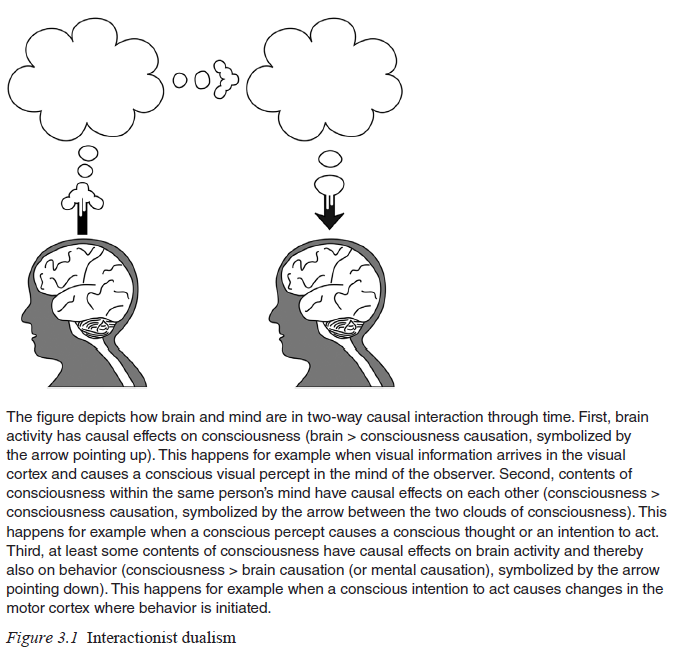
Dualism
- Mental substance does not have any spatial location in the physical space
- Descartes beleived that key organ is pineal gland
- Sir John Eccles (1980.) - the Nobel prize winning (interaction dualism)
- Consciousness consist of non-physical elements called psychons
- They interact with the nerve cells in our body
Weaknesses
- First, a mysterious mental substance (psychons)
- That substance consist of what, which kind of substance
- Replacing one mystery with another without explanation
- Second, interaction between physical brain and non-physical substance
- Without mass, density, spatial location, energy…
Third weakness and strengths (do tu, 21.10.2025.)
- Third weakness; Consciousness depends on brain (different dimension)
- Dualism accepts all results of physical science. The Hard Problem and Explanatory Gas are problems for physical science
- Brain can never explain consciousness because the consciousness is not based on brain activity
- Brain only mediates consciousness and physical world.
- NDE predicted and explained with Cartesian dualism
Theories
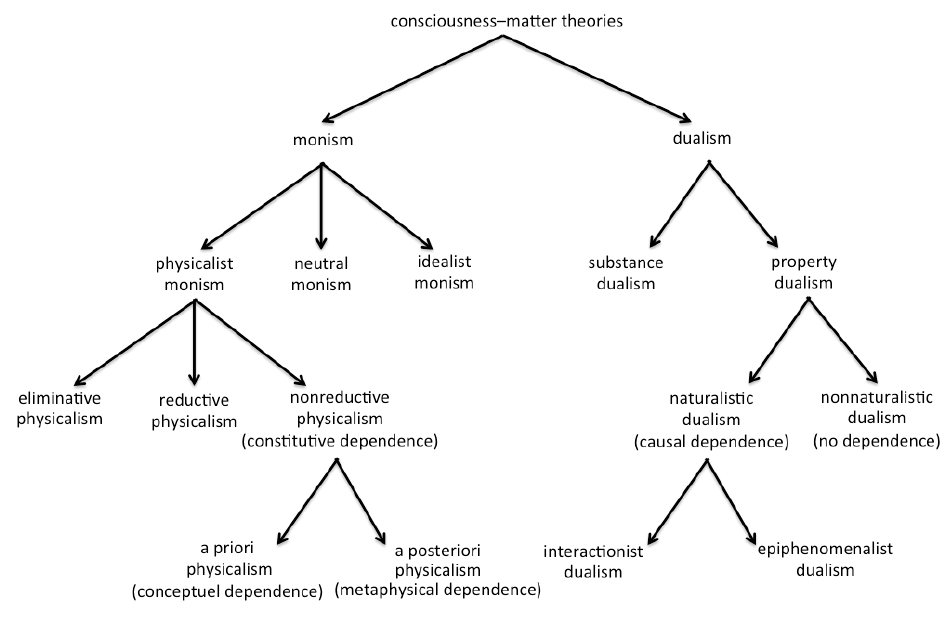
Different theories (Gennaro, 2018)
Monistic materialism (physicalism)
- Our current scientific world-view, evidence, theories
- Non-physical phenomena simply do not exist
- The same laws and fundamental physical forces apply everywhere
- We live in a purely material and physical universe
Two different versions of materialism
- Reductive materialism - consciousness is an ordinary neurobiological phenomenon happening in the brain
- Emergent materialism - consciousness is not an ordinary physical phenomenon
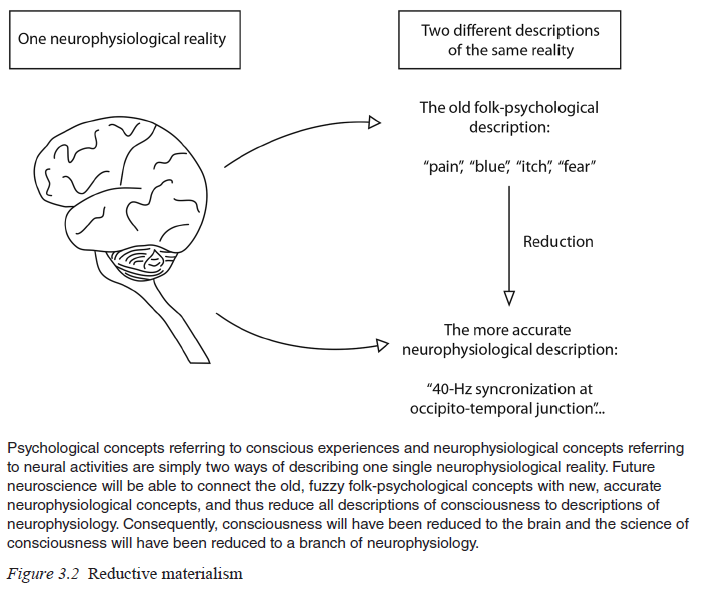
Reductive materialism
- We have different concepts in our everyday language that refer to physical phenomena (water, light, temperature)
- In the same time without thinking about deep understanding of that phenomena (H20, electromagnetic radiation…)
- The same process in physical science: reduction, reductionism (complex phenomena, molecule level, atomic level…)
- That is Atomic theory of matter
- The same principle working in biology: Cell theory of life
The same process but…
- Consciousness will probably follow the same pattern
- The same approach does not seem appropriate
- Why some neural activities produce some kind of subjective experiences but the other not?
- DNA molecule is not person…
- Electorchemical activities is not subjective experience of colour. Qualitative features are not possible to explain by brain electrophysiology
Reductive materialism
Consiousness and personal identity
Several intersecting questions are in play in philosophical discussions of personal identity (Kind, 2018):
- What makes someone a person, personhood?
- Nature of self-identification: What makes someone the particual person that she is?
- Nature of person’s existence through time: What makes a person the same person over time?
Reductionism
- Microphysicalism: Microphysical levels are everything that really exists
- Macroscopic objects - illusion by human perception
- Problem: Why only the microscopic bottom level of the physical world is real?
Emergent materialism
- Different direction than previous
- Phyisical world is a layered system: different levels of organisation
- Consciousness is one of the higher level of organisation
- Consciousness is emergent phenomena: emerge from the lower-level phenomena
- Life is emergent physical phenomenon
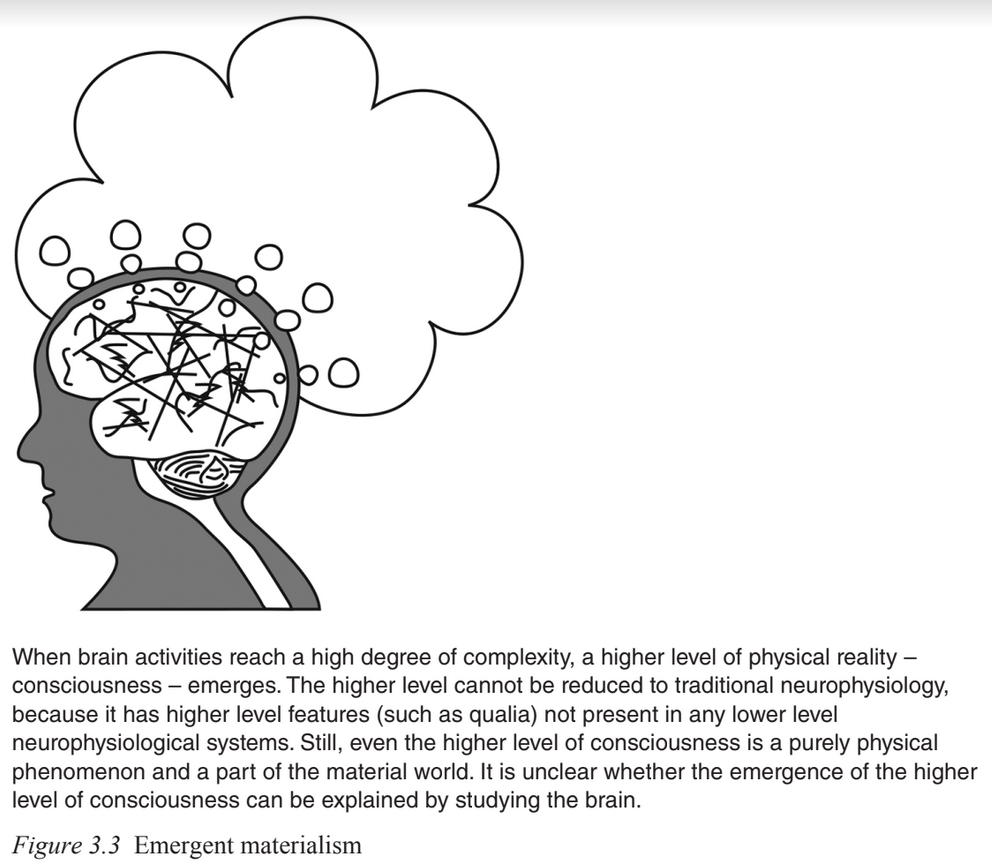
Problems with Emergent materialism
- Why and how higher level of consciousness can be explained by studying the brain?
- Strong emergence - pessimistic variety of emergent materialism
- Mysterianism - consciousness would be a mystery forever for the science
Idealism
- Opposite to materialism
- Physical matter is illusion
- Our reality — complex mental image, not real
- Scientific world-view depends on the observations of scientists - observation about the physical world
Idealism
- Scientists never see anything real physical
- They only see patterns of subjective observations
- That is only subjective experience
- We have seen the ‘physical world’ with indirect evidence
- We could not see as it is!
- Charles Sanders Peirce: modern proponents of objective idealism. The father of Objective idealism starts with Plato’s theory of forms; objectively existing but non-material “ideas” give form to reality.
Idealism
- This is the same as Descartes theory
- One of the famous idealist in phylosophy George Berkeley (1685-1753) - immaterialism
- Immanuel Kant: “transcendental” and “critical” idealism, Kant describe himself as “empirical realism” with “transcendental idealism”
- Quantum mechanics: properties of the elementary physical entities defined by whether or not those entities are being observed by somedody
- observed create the world whenever hey decide to look at it and destroy it when they turn theri gaze away from it (Revonsuo, 2017)
Neutral monism
- Neither mental nor physical
- Double-aspect theory: contains both mental and physical phenomena
- Similar to particle-wave duality in quantum physics
- Orch-OR quantum theory of consciousness (Li et al., 2019)
- Without observation: particle exist in some neutral state, indeterminate form
Neutral monism
- When subject observes, consciousness from the inside: shows itself in the form of phenomenal experiences
- External observer without self experience of subject: neutral structures and electrochemical activities can be seen
- Consclusion: first-person and the third-person perspective cannot be taken at the same time
- This theory of consciousness call Velmans Reflexive monism according to Revonsuo (2017)
- Two main problems: neutral state and how double aspect manifested in the brain?
Neutral monism
- Panpsychism: every molecule, atom or elementary particle contains some kind of conscious ingredient
- Consciousness is the result of the accumulation and complex organization
- David Chalmers (1996) and Giulio Tononi (2008)
- Integrated Information Theory (IIT): higher degree of integrated infromation is conscious
- Any physical system have some kind of integrated approach (the same: computer and human)
Functionalism
- Something between neutral monism and dualism
- complex causal relationship
- a mental state is function of information system
- functionalists are materialists
- 2014 movie Transcendence - copy the consciousness to the quantum computer
Functionalism
- the seat of the consciousness is not the brain
- that could be any kind of the computer
- functionalism gives no account on qualia, qualitative, subjective experience
Consciousness is not in the brain
- Consciousness outside of the Head? (Tonneau, 2004)
- Arguments that the consciousness is not in the brain
The three most important (structure) concepts
- Phenomenal consciousness
- Reflective (or access) consciousness
- Self-awareness
Literature
Gennaro, R. J. (2018). The Routledge Handbook of Consciousness. Routledge, Taylor & Francis Group.
Kind, A. (2018). Consciousness, personal identity, and immortality. In R. J. Gennaro (Ed.), The Routledge Handbook of Consciousness. Routledge, Taylor & Francis Group.
Kupisz, P. (2019). How Can the Human Soul Interact With the Physical Body? In Worldview Summit. https://www.worldviewsummit.org/post/how-can-the-human-soul-interact-with-the-physical-body
Li, T., Tang, H., Zhu, J., & Zhang, J. H. (2019). The finer scale of consciousness: Quantum theory. Annals of Translational Medicine, 7(20), 585. https://doi.org/10.21037/atm.2019.09.09
Revonsuo, A. (2017). Foundations of consciousness (1st ed.). Routledge.
Riekki, T., Lindeman, M., & Lipsanen, J. (2013). Conceptions about the mind-body problem and their relations to afterlife beliefs, paranormal beliefs, religiosity, and ontological confusions. Advances in Cognitive Psychology, 9(3), 112. https://doi.org/10.2478/v10053-008-0138-5
Santoro, G., Wood, M. D., Merlo, L., Anastasi, G. P., Tomasello, F., & Germano, A. (2009). The anatomic location of the soul from the heart, through the brain, to the whole body, and beyond: A journey through Western history, science, and philosophy. Neurosurgery October 2009, 65(4), 633–643. https://doi.org/10.1227/01.NEU.0000349750.22332.6A
Tonneau, F. (2004). Consciousness outside the Head. Behavior and Philosophy, 32(1), 97–123. https://www.jstor.org/stable/27759473
Van Bael, K., Ball, M., Scarfo, J., & Suleyman, E. (2023). Assessment of the mind-body connection: Preliminary psychometric evidence for a new self-report questionnaire. BMC Psychology, 11(1), 309. https://doi.org/10.1186/s40359-023-01302-3