Definition and history of consciousness
Course description
Interdisciplinary,
drawing on material from philosophy, psychology, neuroscience,
cognitive science, religion and artificial intelligence
Why Psychology of Consciousness
- one of the most important topics for the twenty-first century.
- combines the best of psychology, neuroscience, and philosophy, as well as requires other disciplines and natural sciences (physics, chemistry, and biology).
- is the most mysterious of all things
- consciousness by its very nature is subjective (qualia).
- we exist within our consciousness, and so do all thoughts / investigations of consciousness.
Why Psychology of Consciousness
- Investigation of consciousness absolutely requires a complex and integrative approach blending many fields of study and scholarship
- I think, therefore I am? (Anglin, 2014)
- Consciousness itself, of course, is the most mysterious of all things that we contend with as human beings (Hashim & Alexiou, 2022).
Content, topics
- Definition of consciousness
- What is consciousness?
- History of consciousness
- Methodology / research of consciousness
- The philosophical foundations of consciousness science
Content, topics
- Neuroscience / neuropsychology of consciousness
- Empirical theories of consciousness
- Sleep and dreaming
- Meditation, contemplation, religion and consciousness
- Altered states of consciousness
- Mental disorders and consciousness
- Psychoactive substances and consciousness
Definition of consciousness
- consciousness by its very nature is difficult to define
- we can start and explore/deal with historical definitions.
- it is also interesting to consider consciousness from various scholars including philosophers, theologians, biologists, and even those who pur- sue artificial intelligence.
- different type of definition for consciousness are more practical and some other are esoteric.
- from scientific point of view, we also have to consider a more operationalized perspective.
Different definitions
- does not exist unify definition
- dichotomy between reductionism and antireductionism
- does it mean self-consiousness
- some definition articulate integration of information (binding);
- some definition connect consciousness and awareness or consciousness and will (one of the hard problem - free will)
Dimensional definition
- Consciousness as sensory consciousness
- Consciousness as selective attention
- Consciousness as inner consciousness
- Consciousness as self integrity, experience of self
- Consciousness as a state of alertness
Different methodology
- operacionalisation of concepts
- measuring of consciousness
- different experimental models
- clinical or case studies
What is consciousness?
- Consciousness describes our awareness of internal and external stimuli.
- Awareness of internal stimuli includes feeling pain, hunger, thirst, sleepiness, and being aware of our thoughts and emotions.
- Awareness of external stimuli includes seeing the light from the sun, feeling the warmth of a room, and hearing the voice of a friend.
Where is consciousness?
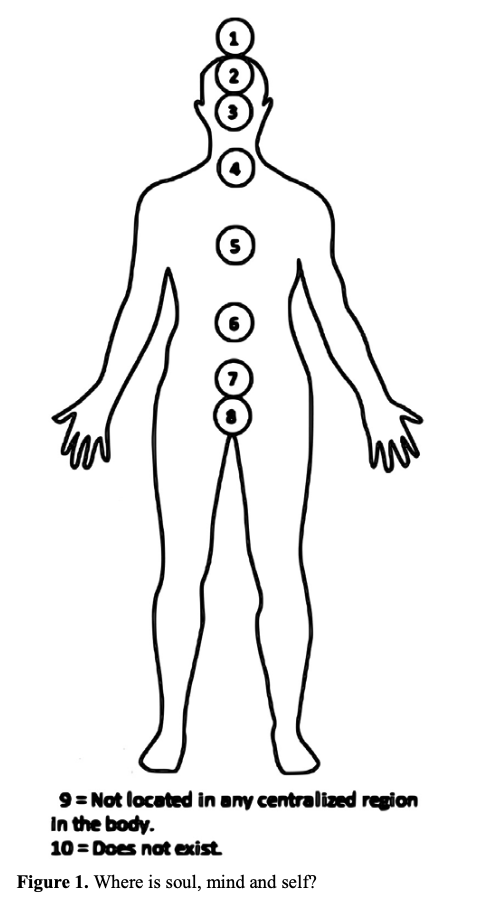
Interoception
The sense that provides the brain with information about the internal state of the body
The Sensation Manikin (SM) is a digital tool used to map and measure bodily sensations, including their location, intensity, and affective dimension (pleasantness or unpleasantness)
History
- Middle ages, Christianity
- First half of 16. century: anima, animus
- John Locke (1632–1704)
- Rene Descartes (1596-1650)
- Cartesian Dualism
- Sigmund Freud
- Modern theories about consciousness
The historical foundations of concsiousness science
- Although the science of consciousness in its modern form emerged only recently (during the 1990s), the study of consciousness has its roots deep in the history of psychology
- Consciousness went through between the 1870s and the 1990s – during the roughly 120 years before the emergence of the current “new wave” of consciousness research.
The historical foundations of consciousness science
- The 1800s: From philosophy to experimental science of consciousness
- Wundt (1897) – science of immediate experience
- Titchener’s (1899) – science of mental processes
- Introspectionism: The first scientific psychology of consciousness
- From cognitive science to the science of consciousness
Major history stages
- The First Golden Age (1860-1920): definition of psychology as science of the consious mind
- The Dark Ages (1920-1980): rejected consciousness as a topic in psychology and science in general
- The Second Golden Age (from 1990s - ): multi-disciplinary science of consciousness
The First Golden Age
- Psychophysics, G. Fechner
- Introspectionism: S. Wundt, E. Tichener
- Introspectionism: W. James
- Gestalt psychology, holistic field of consciousness
The Dark Ages
- Psychoanalysis and unconsiousness mind: S. Freud
- Behaviorism and the rejection of consciousness
- Cognitive science: mind as computer program
The Second Golden Age
- Cognitive neuroscience
- The sciences of consciousness: philosophy, psychology, neuroscience
Sleep and wakefulness
- awakening, consciousness, brain waves
- EEG and polysomnography
- sleep stages (REM, NREM stages)
- sleep and circadian rhytm
Sleep and wakefulness
- parasomnias (REM Sleep Behavior Disorder (RBD), Recurrent Isolated Sleep Paralysis, Nightmare Disorder, Exploding Head Syndrome, Sleep-Related Dissociative Disorder, Sleep-Related Hallucinations)
- sleep related movement disorders (Restless Legs Syndrome (RLS), Periodic Limb Movement Disorder (PLMD), Sleep-Related Bruxism, Sleep-Related Rhythmic Movement Disorder)
- dream, wakefulness and sleep connection
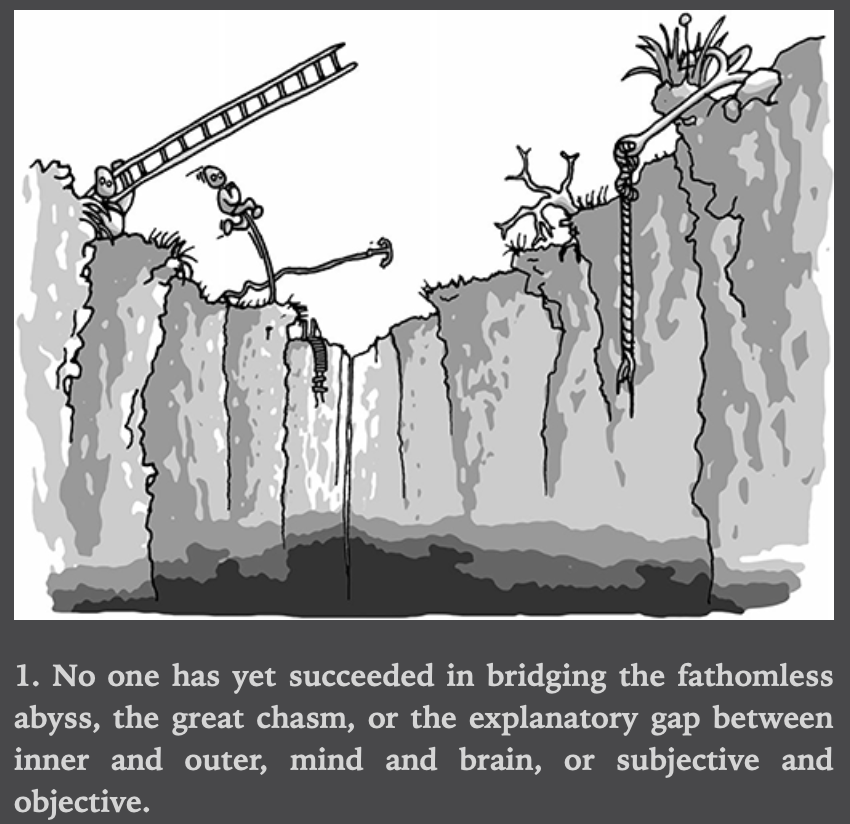
The hard problem
“Consciousness is at once the most obvious and the most difficult thing we can investigate.” (Blackmore, 2018)
“How on earth can the electrical firing of millions of tiny brain cells produce this—my private, subjective, conscious experience?”
The hard problem
“This problem is called the ‘hard problem’ of consciousness, a phrase coined in 1994 by the Australian philosopher David Chalmers. He wanted to distinguish this serious and overwhelming difficulty from what he called the ‘easy problems’.”
“American philosopher Patricia Churchland calls it a ‘hornswoggle problem’, arguing that we cannot, in advance, decide which problems will turn out to be the really hard ones.”
Why the mystery?
Conciousness - term?
- The abstract noun consciousness derived from Latin con (with) and scire (to know) (Gennaro, 2015)
- Consciousness has etymological ties to one’s ability to know and perceive (Gennaro, 2015)
- Confuse with the term conscience which means moral connotation, doing something wrong or right
- Knowledge of external world (x is consious of y) or internal, mental processes (x is consious)
- The word consciousness comes from the Latin term conscĭentĭa that means “knowledge shared with others” (Charlton and Short, 1879) according to Fabbro et al. (2019).
Etymology
- 1630s, “internal knowledge,” from conscious + -ness.
- Meaning “state of being aware of what passes in one’s own mind” is from 1670s;
- meaning “state of being aware” of anything is from 1746.
Etymology
The origin of the modern concept of consciousness is often attributed to John Locke’s Essay Concerning Human Understanding, published in 1690 (New World Encyclopedia)
Locke’s essay influenced the eighteenth-century view of consciousness, and his definition of consciousness as “the perception of what passes in a man’s own mind” (Johnson, 1785)
Etymology
The earliest English language uses of “conscious” and “consciousness” date back, however, to the 1500s. The English word “conscious” originally derived from the Latin conscius (con- “together” and scio “to know”)
the Latin word did not have the same meaning as the English word—it meant “knowing with,” in other words “having joint or common knowledge with another.”
many occurrences in Latin writings of the phrase conscius sibi, which translates literally as “knowing with oneself,” or in other words “sharing knowledge with oneself about something.”
A related word, not to be confused with consciousness, is conscientia, which primarily means moral conscience.
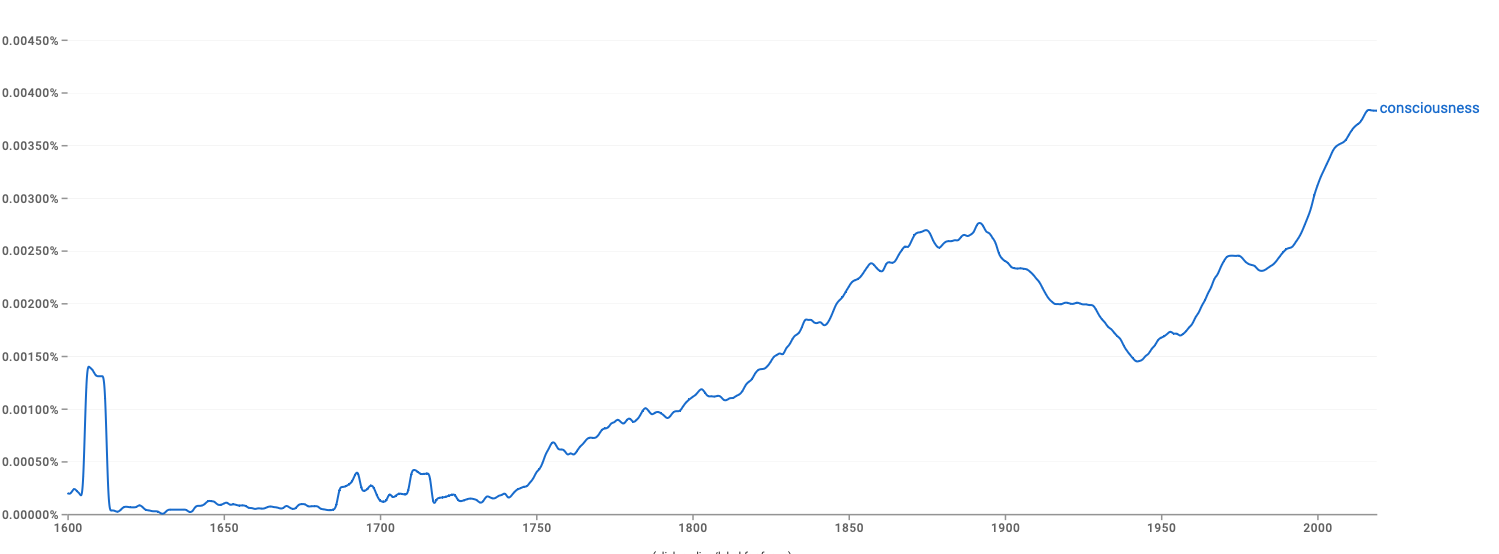
Usage of word - consciousness
Conceptual foundations of concsiousness science
- How to describe the subjective reality of consciousness
- Concepts to describe the absence of consciousness
- Alternative definitions and usages of the concept of “consciousness”
The Science of Subjective Experience
- The Science of Subjectivity (Revonsuo, 2010)
- To study consciousness is to study a deep mystery about ourselves.
- It is to study the nature of our existence, but not the kind of existence that physics and the other sciences study because they study the objective existence of atoms, galaxies, oceans, cells, time and space, among other things.
The Science of Subjective Experience
- To study consciousness is to study the fundamental nature of our personal existence, our subjective existence, our life as a sequence of subjective experiences.
- A conscious being has an internal psychological reality, a mental life consisting of subjective experiences, with a stream of consciousness flowing within.
- “The hard problem: How do subjective experiences arise from objective brains?”
The three most important concepts
- Phenomenal consciousness
- Reflective (or access) consciousness
- Self-awareness
Dream and death (Fan, 2024)
Every night, we die. Consciousness vanishes in dreamless deep sleep and with it the entire world.
What does it feel to be dead? Neither sheer silence nor absolute darkness.
All disappears. Falling asleep is a leap of faith. Consciousness, for us, is the frontier between being and nothingness.
The philosophical foundations of consciousness science
- Dualistic theories of consciousness
- Monistic theories of consciousness
- Mind-body problem and consciousness
- Empirical theories of consciousness
Neural correlates of consciousness
- The answers to these rather fundamental questions depend on what the science of consciousness will find out about our subjective psychological reality and about its physical seat, our brain! (Revonsuo, 2010)
- The role of brain and other location in body for complex dimensions of consciousness
Altered states of consciousness
States that qualitative and quantitative different then normal state of wakefulness:
- dreaming during wakefulness
- sleep / dreaming
- meditation
- contemplation
Altered states of consciousness
- hypnotic trans
- possesion / obsession
- perception distortion according to different psychoactive substances
- psychopathology