Altered states of consciousness
Definition
- Altered states of consciousness (ASCs), also called altered mental states or mental alterations, are states that differ significantly from normal wakefulness.
- Arround 1892, the expression had come into use in connection with hypnosis
- Max Mailhouse (1904) related to epilepsy and is still in use today
- At universities, this expression was used by Arnold M. Ludwig in 1966 and was commonly used by Charles Tart from 1969.: changes induced in a person’s mental state which are mostly temporary, a synonym is altered state of consciousness.
Some lines from history
- Abraham Maslow, Stanislav Grof, and Charles Tart. They focused on seemingly beneficial aspects of ASC
- Abraham Maslow’s research on peak experiences as moments of supreme happiness and fulfillment contributed further to human pathological depathology, changed state.
- Stanislav Grof and others formed a new field, transpersonal psychology, in which they emphasized spiritual importance.
Transpersonal psychology
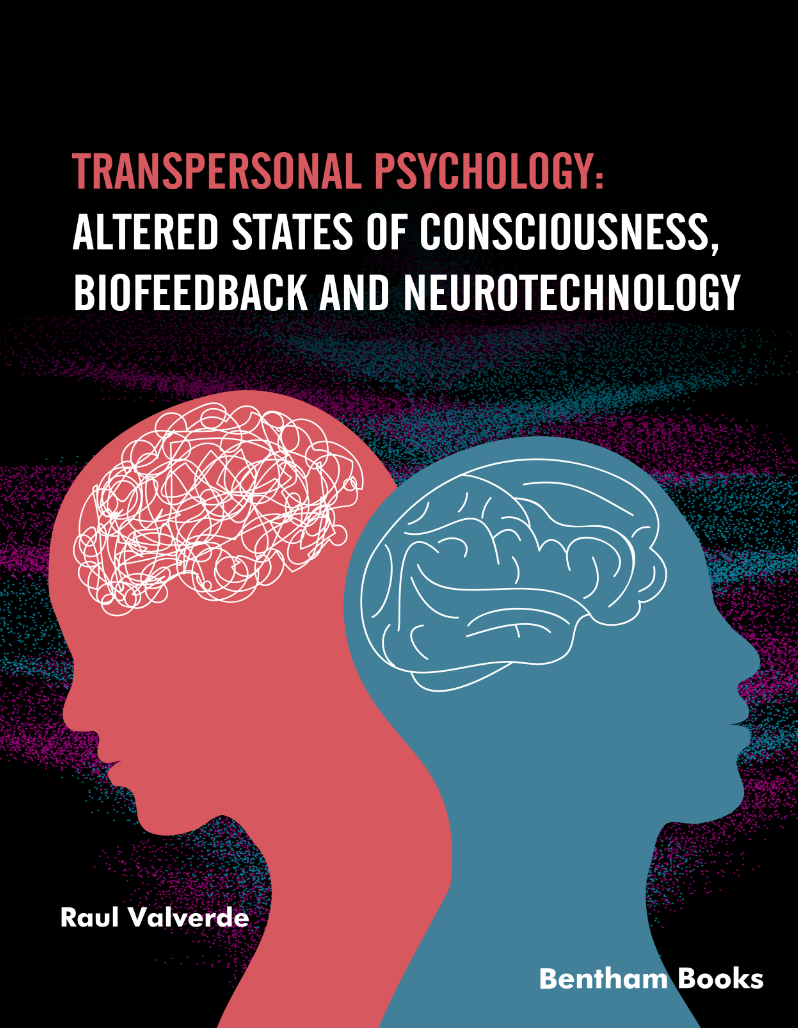
Transpersonal psychology
- Transpersonal psychology is the study of human nature and development based on the assumption that humans have the potential to move beyond the ego’s limitations.
- Transpersonal theory’s main goal is to integrate the spiritual experience into a broader understanding of the human psyche and consciousness.
Transpersonal psychology
- Consciousness can be defined as the set of subjective, immediate, or remote knowledge that each being has about the world and himself and sensory perception of sights, sounds, and smells that are close to us. (Valverde, 2022)
- Three main schools explain consciousness: Neuroscientist, Quantum, and Skeptic. Quantum paradigm that will serve as background for the book (Valverde, 2022)
State of consciousness
Current discussions of consciousness have mostly ignored the fact that we transit among different states of consciousness even while “being awake,” that these states exhibit differing configurations of cognition, emotion, physiology, and behavior (Cardeña & Winkelman, 2012)
Literally problems, confusion with terms - “states of consciousness” reifies consciousness as an entity whereas it is the creature (human or otherwise) who experiences these variations
A phrase such as modalities of experiencing would be a closer indication (James, 1890)
Some authors prefered discrete state of consciousness
Altered states of consciousness
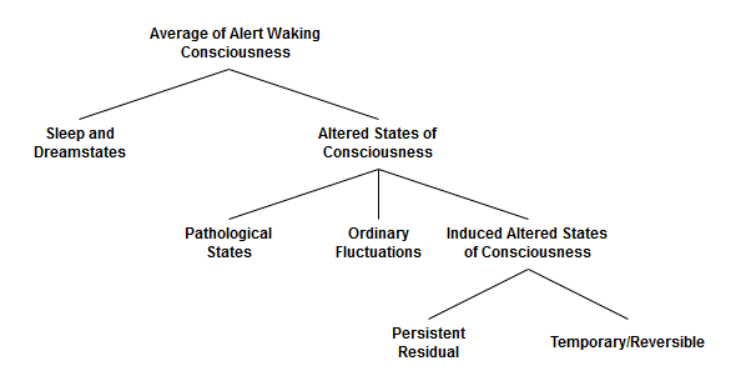
Altered states of consciousness
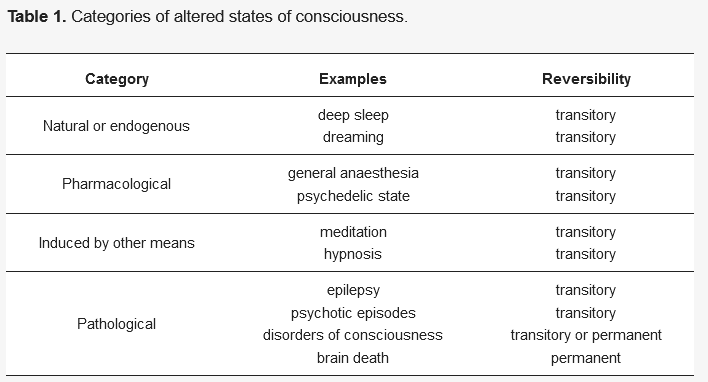
ASC (Cofré et al., 2020)
Time and space
- We perceive our world through its spatial and temporal characteristics.
- The world expands spatially in its three dimensions; equally, our experiences take place in a temporal system of future (expected), present (lived), and past (remembered) events. (Wittmann, 2018)
- During a period of waiting without any distractions, during which nothing much of interest happens, we are particularly aware of the time and it passes slowly!
- Having lived through dangerous situations, people often report that the events took place in slow motion!
Self and time
- Consciousness of self, consciousness of space and consciousness of time (3D important dimensions modulated together)
- Consciousness—moments of shock, meditation, sudden mystical experiences, near-death experiences, influence of drugs — temporal or/and self or/and space consciousness is fundamentally altered (Wittmann, 2018).
Absolutely in the Moment
The moment is the only reality, the essential reality in intellectual life. The lived moment is the last, blood-warm, immediate, living, the present incarnate, the totality of the real, the only concrete thing. Instead of losing themselves in the past and future, away from the present, the individual finds existence and the absolute only in the moment. Past and future are dark, uncertain abysses, they are endless time, while the moment can be the sublation of time, the present of the eternal.
Karl Jaspers wrote this in 1919 in his Psychologie der Weltan- schauungen (Psychology of worldviews). (Wittmann, 2018)
Different categories of ASC
- Spontaneous States: daydreaming, drowsiness, dreaming
- Intentionally or psychologically induced: meditation, contemplation, religious mystical/visions, hypnosis, sensory deprivation
- Physically induced: orgasm, hallucination, oxygen or food starvation, anesthesia
- Psychopathological or neurological changes of consciousness, spirit possesion
Taxonomy of ASC
- Based on their central phenomenological features (Cardeña et al., 2025)
- Modified Delphi methodology
- International group identified eight distinct phenomenological/behavioral states
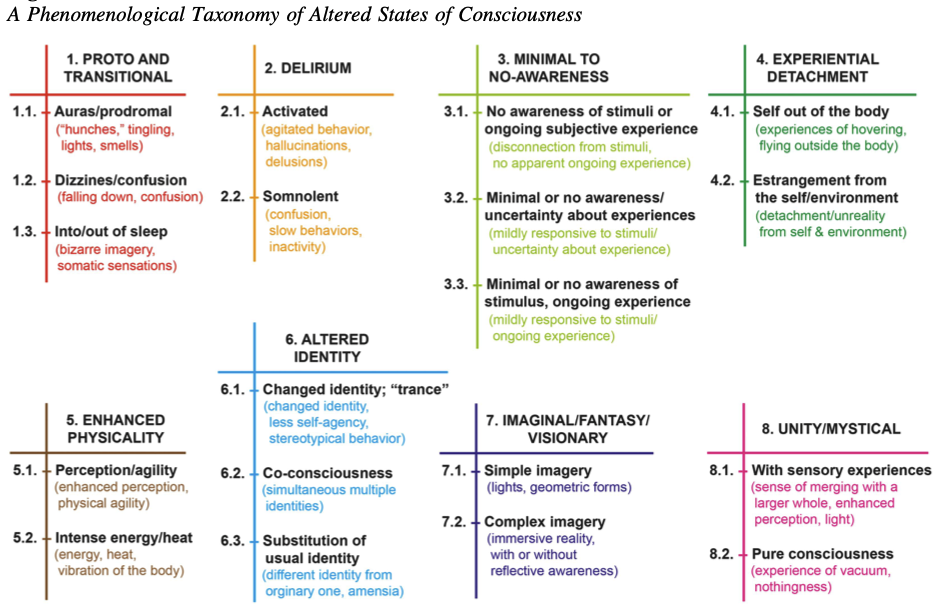
Confusion with other terms
- Trance - nebulous and unspecified ASC
- Ecstasy
- Higher states of consciousness
- Absorption
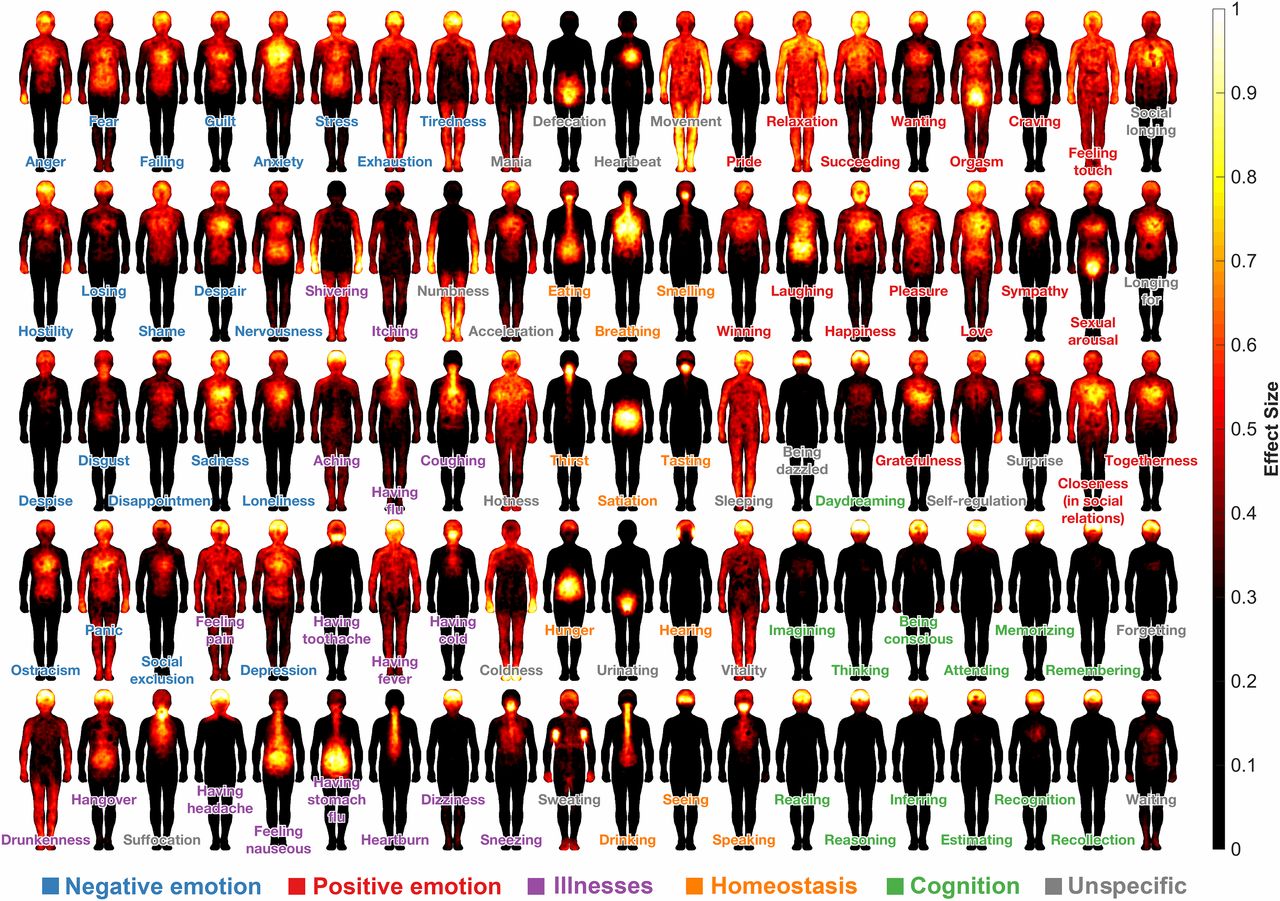
Maps of subjective feelings are very complex
- Subjective feelings are a central feature of human life
- Feelings formed five groups: positive emotions, negative emotions, cognitive processes, somatic states, and homeostatic states (Nummenmaa et al., 2018)
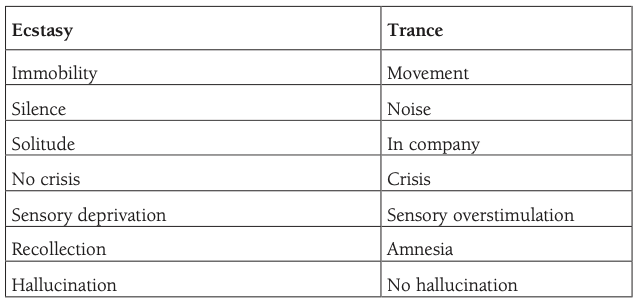
Trance vs. ecstasy
- The literature includes many different and partly contradictory definitions of the terms trance and ecstasy (Fechner, 2012)
- Trance (Latin: transire - passing through) and ecstasy (Latin: exstasis - to be out or stand out of stasis)
- Trance is always associated with a greater or lesser degree of sensory overstimulation—noises, music, smells, agitation— Ecstasy, on the contrary, is most often tied to sensorial deprivation—silence, fasting, darkness (Fechner, 2012)
Trans vs. ecstasy (Fechner, 2012)
Sound, noise and music
- Sound, noise and music: different terms that are so important for consciousness. Because of that in our course we have excercises in sensory deprivation and also the last lecture (sound and noise)
- Sound profoundly impacts consciousness by altering brainwaves, shifting emotional states, and influencing cognitive functions (attention, focus, creativity, relaxation)
- Important of being in the moment and silence! (example: mygrene: noise is a major trigger, the importance of silence in religion: more detail with excercises in the course Psychology of religion)
- Why sing when you can talk?
Sound weapons
- Sound, noise: huge impact on human behaviour
- Called sonic or acoustic weapons
- Use intense sound or ultrasound to incapacitate or harm people
- Ranging from Long-Range Acoustic Devices (LRADs) to high-pitched deterrents (Mosquito) or even fear-inducing sonic booms
- Uses in military/police settings for crowd control, piracy, and personal security
Why music?
- There is no doubt that music forms an opposition to language (Klempe, 2022)
- The philosopher G. W. F. Hegel: music must generally be understood as a romantic art form.
- Music appears as a kind of language of emotions; brings to life what we call soul.
From ancient time to modern period
- From Pythagoras and Plato, music had been perceived as a mathematical science.
- That understanding remained throughout the Middle Ages but dissolved and changed radically with the advent of modernity in the seventeenth century and until the present day.
- Today: importance of Synesthesia and Metacognition (Klempe, 2022)
Evaluation of noise, sound
- Perceptual Psychoacoustic Subjective (PPS) scale: Designed to quantitatively assess fundamental perceptual dimensions of sound in an acoustic environment
- Noise Exposure Questionnaire (NEQ): Used to estimate an individual’s annual noise exposure and identify those at risk of noise-induced hearing loss
- Sound Sensitivity Symptoms Questionnaire (SSSQ2): A questionnaire used to measure the severity of symptoms for various forms of sound sensitivity, including hyperacusis and misophonia
Sound impact
- Sound Sensitivity Symptoms Questionnaire (SSSQ2): This six-item questionnaire assesses the severity and frequency of various sound sensitivities
- Hyperacusis Questionnaire (HQ): A 14-item scale designed to measure hypersensitivity to sound, with higher scores indicating greater sensitivity.
- Psychoacoustics Perception Scale (PPS): This quantitative subjective scale assesses fundamental perceptual dimensions of sound
Religion and consciousness
- Experiments with Carmelite nouns and Budist monk (Beauregard, 2012)
- Although there are many different kinds of and approaches to the spiritual experience, it is always about the merging of the individual with the whole, about sinking into the encompassing, the experience of the absolute, of transcendence (Wittmann, 2018).
- In the Christian context it is about knowing God as becoming one with God, the unio mystica.
- In the spiritual experience, self (subject) and world (object) are no longer separate.
- The transition from linear to mystical time
Spirit Possession and consciousness
- In the Western Christian tradition, self and consciousness have always been bound with notions of a relatively coherent inner self and the existence of external agencies—spirits—that, at times, can take possession of this inner self and change it. Sluhovsky, M. in (Cardeña & Winkelman, 2012)
- The change could last anything from a few seconds to a lifetime
- Could be voluntary or involuntary, and
- Could have either permanent or only short-term impact on the living subject whose self is being possessed.
- Dramatic possession (Divine or Devil) changes cognition, self, emotion, somatic states, language.
- Exorcism through history (one of the famous case in 20th century: Anneliese Michel (1952-1976))
- The Exorcism of Emily Rose (2005): one of the famous movie is based upon a true story
NDE
- Near-death experiences (NDEs) are reported by about 17% of those who nearly die.
- NDEs have been reported by children, adults, scientists, physicians, priests, ministers, among the religious and atheists, and from countries throughout the world. (Long, 2014)
- Systematic reviews of NDE: 2,407 studies were included, 54 of which underwent final examination (Hashemi et al., 2023)
NDE systematic reviews
- The most frequent near-death experiences were supernatural experiences; the experience of leaving the body.
- There is a common core among them such as out-of-body experiences, passing through a tunnel, heightened senses, etc. (Hashemi et al., 2023)
NDE case studies
- Oldest NDE: Plato in Republic, 380 BC, Myth of Er (the story and case of Er)
- Anita Moorjani (Moorjani, 2012)
- Musicophilia, A Surgeon struck by lightning (Sacks, 2008)
- Eben Alexander (neurosurgeon from Duke University) (Alexander, 2012)
NDE case studies
- Reverend Don Piper of Pasadena (Piper & Murphey, 2004)
- A Four-year-old Colton, father published a book (Burpo & Vincent, 2010)
- George Rodonaia (M.D. and a Ph.D. in neuropathology) https://www.youtube.com/watch?v=jcEbQdy-BAM (Berman, 1998)
Musicophilia (Sacks, 2008)
- A surgeon struck by lightning in a phone booth survives this near-death experience
- After NDE develop a curious, out-of-nowhere, out-of-character craving for learning the piano, and piano music
- Developed “musical hallucinations” in a whole host of subjects
- A musical savant with a ‘phonographic’ memory for melodies of hundreds of operas in their entirety, which includes individual instrumental and vocal parts; and so on.
- Musicophilic also showed significantly increased regional grey matter in the left posterior hippocampus (a memory area) (Fletcher et al., 2013)
Consciousness and psychoactive drugs
- lecture from Marija Franka Žuljević
- documentary film Scopolamine (Duffy, n.d.)
- document leading board for drugs: problems of classification (Dreifuss, 2019)
State of consciousness and ASC
- explain the difference in state of consciousness and other… Cardena (Cardeña & Winkelman, 2012)
- Chapter 1: Altering Consciousness: Setting Up the Stage (1-23)
- Chapter 4: Spirit Possesion and Other Alterations of Consciousness in the Christian Western Tradition (73-89)
- Chapter 7: Eastern Approaches to Altered States of Consciousness (139-159)
- Chapter 12: Altered Consciousness in Religion (255-277)
- Chapter 16: Time Is the Key: Music and Altered States of Consciousness (355-377)